


Phone: (914) 381-2400E-Mail: customerservice@marvalindustries.com
Electronics manufacturers should consider custom color compounding when standard resin colors cannot meet a product's appearance requirements or when a different method of introducing color would better suit production. The decision depends on the color specification, the resin used for the component, and how consistently the manufacturer needs to reproduce the finished appearance.
For a single enclosure with flexible appearance requirements, an existing colored resin may be sufficient. The decision becomes more involved when a new housing must match an established product line, several molded components must appear consistent when assembled, or production requires the same color over multiple orders.
At Marval Industries, we provide color matching and custom color compounding services. We help manufacturers evaluate color development alongside the materials and processing methods used to produce their components.
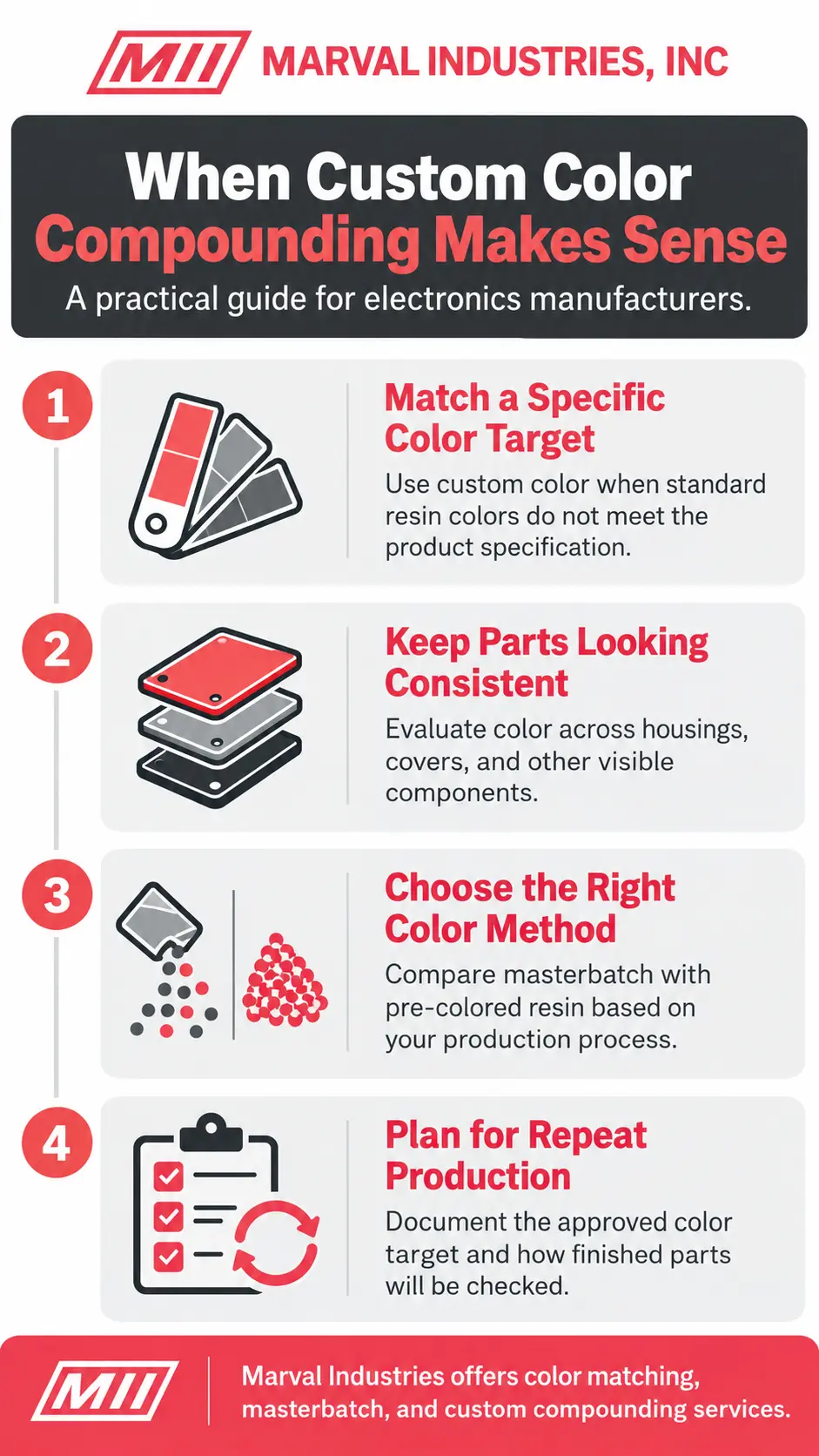
Standard resin colors provide a practical starting point for many electronics applications. However, a manufacturer may need a specific shade that is unavailable in the selected resin grade.
Consider an electronics company expanding an existing product family. Its new enclosure must coordinate with equipment already on the market, but the available gray resin has a different appearance. Choosing that material may create a visible difference between products intended to share the same design.
Custom color compounding allows manufacturers to pursue a defined color target rather than limiting their selection to commercially available shades. This can be useful when developing branded housings, exterior covers, control panels, or accessories intended to coordinate with existing products.
The important distinction is whether the color difference is acceptable within the product specification. A custom formulation may be justified when appearance requirements are specific, but it adds little value when an existing resin already meets them.
Manufacturers should also avoid changing resin families simply to obtain a preferred color. The selected material may have mechanical, thermal, or processing characteristics that the finished component requires. Developing color within an appropriate resin system can address appearance without overlooking the original material requirements.
Why a Successful Color Match May Look Different in the Finished Product
Achieving the desired color in a sample is different from reproducing its appearance in a molded component.
Surface texture, gloss, material characteristics, and viewing conditions can influence how people perceive color. Researchers at the National Institute of Standards and Technology (NIST), in their publication Color and Appearance, explain that accurate appearance evaluation must account for more than color alone. Lighting and viewing conditions can change how a material appears, while gloss and other surface characteristics introduce additional measurement considerations.
For electronics manufacturers, this distinction matters when separate components must look consistent after assembly. A smooth housing and a textured cover may appear different even when their materials were developed around the same color target.
It also affects how manufacturers approve a new formulation. A resin sample may demonstrate that the desired shade is achievable, but it cannot fully represent every surface and manufacturing condition associated with the finished product.
We recommend evaluating color against representative molded components when the final appearance matters. A defined color target provides a reference, while assessments of actual parts help determine whether the result meets the intended design.
This approach is particularly relevant when manufacturers use different molds or materials for components that must appear together.
Once a manufacturer establishes the desired color, the next decision concerns how that color enters the manufacturing process.
A color concentrate contains concentrated colorants dispersed in a carrier resin. During molding or extrusion, the manufacturer combines the concentrate with a compatible base resin at a specified ratio. This allows a facility to produce different colors using the same base material without purchasing a separate pre-colored compound for every variation.
Fully compounded, pre-colored resin follows a different process. The colorants are incorporated into the material before it arrives at the molding facility, eliminating the need to meter a separate color concentrate at the molding machine.
The distinction affects material handling, inventory, and production planning.
A manufacturer producing several colors of the same electronic accessory may prefer the flexibility of adding concentrate during processing. A facility manufacturing large quantities of one colored enclosure may find pre-colored resin more practical because it reduces the number of separate material additions.
Neither option automatically produces a more consistent finished color. With a color concentrate, the manufacturer must manage the addition ratio, mixing, and processing conditions. Pre-colored resin removes the separate color-addition step, but molding conditions and other factors can still influence appearance.
The choice should reflect the actual production arrangement. Manufacturers need to consider how frequently colors change, the quantities produced, available equipment, and the additional material-handling requirements of each method.
Maintaining a consistent appearance becomes more challenging when an electronic product contains components manufactured separately.
An enclosure may include a main housing, removable cover, control panel, and accessories. These components can differ in surface finish, thickness, or resin grade, even when they belong to the same product.
A single-color formulation may not produce an identical appearance across those materials. Instead, manufacturers may need to develop appropriate formulations for different resin systems while working toward a common visual target.
The same issue can arise when producing replacement components for established equipment. A newly molded cover may need to coordinate with a housing manufactured several years earlier. Without a documented appearance specification, determining whether the replacement is acceptable becomes subjective.
Manufacturers should therefore consider how approved colors are recorded and how future components are evaluated against those references.
This does not necessarily require one identical compound for every part. It requires a defined appearance target and a method for determining whether the finished components meet it.
For manufacturers producing the same electronic components over extended periods, color development should account for future production runs.
An approved initial sample establishes a useful reference, but manufacturers also need to consider how subsequent material batches and molded components will be assessed. Differences in processing conditions, surface finish, or material characteristics can create appearance variations even when a formulation remains unchanged.
Color specifications can help establish acceptance criteria for future orders. Depending on the application, manufacturers may use physical reference samples, instrumental color measurements, or evaluations of finished components under agreed viewing conditions.
The chosen method should reflect what matters to the product. A numerical color measurement can identify a difference, but it may not fully describe how two assembled components appear together.
For this reason, recurring production may require both a documented material formulation and an agreed approach to evaluating the finished parts.
At Marval, our color matching and compounding capabilities provide manufacturers with options for developing colored materials around their application requirements. The manufacturer must still determine how the formulation will be processed and evaluated within its own production operation.
Custom color compounding is most appropriate when manufacturers need a specific appearance that standard materials cannot adequately provide or when a particular color-supply method offers a practical production advantage. The decision should begin with the required resin, the finished component's appearance, and the manufacturing process rather than assuming that custom materials are always preferable.
Marval Industries provides custom color matching, color concentrates, and fully compounded color solutions. Manufacturers evaluating these options can discuss their existing resin, color target, and production requirements with our team to determine which approach merits further consideration.
315 Hoyt Ave Mamaroneck NY 10543
customerservice@marvalindustries.com
customerservice@marvalindustries.com
(914) 381-2400


