


Phone: (914) 381-2400E-Mail: customerservice@marvalindustries.com
A perfect chip can create a false sense of certainty. The color may look right under a light booth, measure close on a spectrophotometer, and satisfy the target standard in a small lab sample. That result still may not hold once the material is exposed to production-speed equipment, real tooling, normal heat history, and routine lot variation.
In plastics manufacturing, color is not only a formula. It is the visible result of resin behavior, pigment dispersion, thermal exposure, shear, part geometry, cooling, and inspection conditions working together. A lab match demonstrates that a target color can be achieved under specified conditions. In contrast, production approval proves that the color can be repeated under the conditions that will actually govern manufacturing.
A color match is a development milestone, not a complete manufacturing decision. It confirms that a target appearance can be approximated visually or instrumentally in a controlled setting. It does not confirm that the same appearance will remain acceptable after a change in resin lot, wall-thickness shift, process adjustment, or different viewing conditions.
Each approval step controls a different level of risk. A plaque may be useful for early comparison, and a lab chip may be necessary for formulation work. Production approval has to go further because it must connect the color to the actual material, process, part, and inspection standard.
|
Approval Step |
What It Confirms |
What It Does Not Confirm |
|
Lab color match |
Target color can be reached under controlled conditions |
Repeatability across production lots |
|
Sample plaque review |
Color works on a standard specimen |
Appearance on final part geometry |
|
Trial run |
Formula behaves under selected machine settings |
Stability across the full operating range |
|
Production approval |
Color meets agreed criteria in real-use conditions |
Unlimited tolerance for resin or process variation |
This distinction matters because color failures often appear after the match has already been accepted informally. A formula can look accurate in a lab setting but shift when melt temperature, residence time, screw design, cooling rate, or surface finish changes. Marval Industries treats production approval as a documented manufacturing standard rather than a one-time visual match.
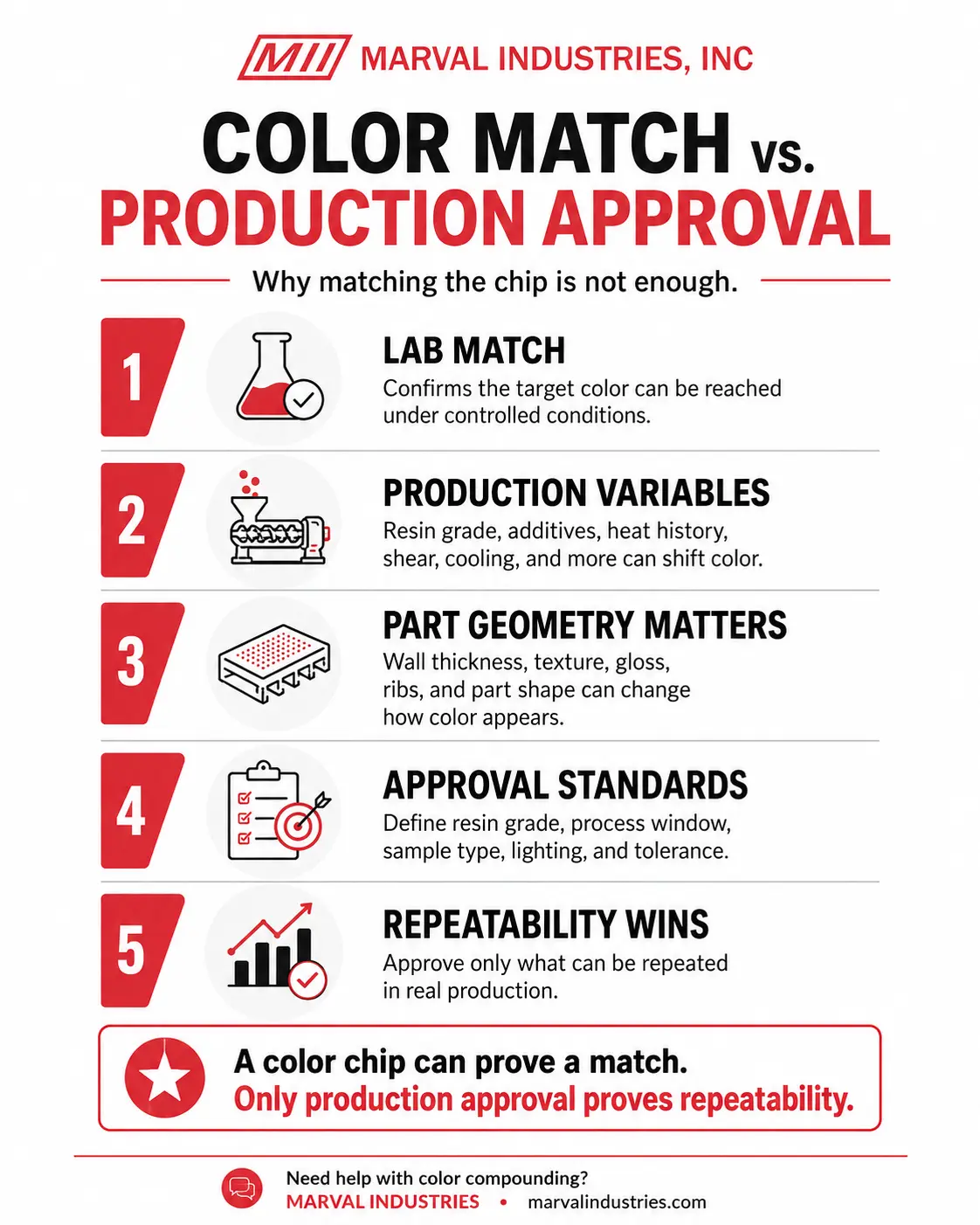
Repeatable color depends on the full material and process system. Resin grade affects opacity, undertone, crystallinity, melt flow, and pigment interaction, even when the polymer family remains the same. Additives can also change appearance because stabilizers, flame-retardants, fillers, lubricants, regrind, and processing aids may influence dispersion, gloss, or light transmission.
Processing conditions can create the same kind of shift. A history of high heat may darken sensitive pigments, while insufficient shear can leave color poorly dispersed. Cooling rate and mold temperature can affect crystallinity and surface texture, which in turn change how the finished part reflects and scatters light.
That is why production color cannot be treated as a static lab outcome. The same formula can behave differently when resin grade, heat history, shear, cooling, or tooling changes, and those changes are often enough to move a part outside the approved visual expectation. This production-color issue is not that lab matching is unreliable; it is that lab matching controls fewer variables than production must control. A 2024 peer-reviewed study titled “Evaluating Processing Parameter Effects on Polymer Grades and Plastic Coloring: Insights from Experimental Design and Characterization Studies,” published by MDPI in Polymers, addresses processing parameter effects on polymer grades and plastic coloring. The source text does not provide extractable universal ΔE values for resin grade, letdown ratio, temperature, or cooling rate. It supports the broader point that resolving material and processing issues is essential to improving plastic coloring outcomes. That matters for approval because the risk is not limited to whether a target can be matched once under controlled conditions. The approval decision must confirm whether the selected color system can withstand the production variables that will shape the finished part.
In practice, the most important variables are usually those most likely to differ between the match and production environments. Those differences may seem minor during development, but they can become visible once the material is processed at scale. A production approval process must account for variables that can affect color after the lab match is complete.
Part geometry deserves special attention because color is judged on the finished component, not in the melt stream. A thin wall may look lighter or more translucent than a thick section made from the same formulation. A textured surface can scatter light differently than a polished surface, so a technically close match may still appear wrong on the actual part.
Production approval should define the conditions under which the color is acceptable. Without that structure, approval becomes subjective and difficult to defend during repeat orders, customer inspections, or lot-to-lot comparisons. A signed chip or plaque alone is not enough if it is disconnected from resin grade, process conditions, sample type, measurement method, and tolerance limits.
A strong approval standard also reduces disagreement between visual and instrumental review. A part may pass under one light source and fail under another, especially when metamerism is present. Spectrophotometer readings can also vary depending on geometry, surface texture, gloss, sample preparation, and the chosen color-difference formula.
A production-ready color approval usually requires defined controls before release. Those controls need to be specific enough to guide repeat orders, not just broad enough to support a first signoff. The goal is to make the approval repeatable across material handling, processing, inspection, and customer review.
The signed production sample becomes the practical reference point because it captures the combined effect of resin, colorant, tooling, process, surface, and inspection conditions. It also prevents future orders from being judged against memory, informal preference, or an isolated lab result. When repeat production is evaluated against the same documented standard, color control becomes a manufacturing discipline rather than a subjective debate over appearance.
A successful color compounding program should not treat a standalone color match as full production approval. The only color that matters in manufacturing is the one that can be repeated with the specified resin, equipment, processing window, sample form, and inspection criteria. A close match is valuable, but it is only the beginning of the approval process.
The strongest approval decisions are built around repeatability. They account for resin behavior, pigment dispersion, heat history, shear, geometry, cooling, surface finish, lighting, and measurement conditions. This approach reduces scrap, delayed launches, customer disputes, and inconsistent repeat orders because the approval reflects how the part will actually be made.
Production approval should be signed only after the color has been validated against the actual resin, process window, representative sample, inspection method, and tolerance standard. That discipline protects both the supplier and the customer because it makes the accepted color tied to real manufacturing conditions. It also turns color approval from a one-time appearance judgment into a repeatable production control.
315 Hoyt Ave Mamaroneck NY 10543
customerservice@marvalindustries.com
customerservice@marvalindustries.com
(914) 381-2400


