


Phone: (914) 381-2400E-Mail: customerservice@marvalindustries.com
A molded plastic part can match the approved color chip in a lab and still look wrong on a retail shelf, under office LEDs, in fluorescent aisles, inside a vehicle, or outside in daylight. In plastic color compounding, that failure is not always a pigment mistake. The final appearance depends on how the resin, colorant package, wall thickness, surface texture, gloss, part geometry, and light source work together.
For buyers approving colors for plastics, the real question is not whether the part matches under one controlled viewing condition. The real question is whether the color holds up under the lighting conditions in which customers, inspectors, and end users will see the finished product. That is why metamerism should be addressed before production approval, not after a part reaches the shelf, assembly line, or field.
A plastic part can pass color approval in a light booth because the approved chip and molded sample are judged under a single controlled illuminant. Once that same part moves into a retail aisle, office, vehicle interior, patio, or daylight setting, the light source may emphasize different wavelengths. The result is a color match that looked acceptable during approval but becomes visually unstable in real use.
Different light sources do not show color the same way. LEDs, fluorescents, filtered daylight, and direct sun each have different spectral characteristics, so they can expose differences between the approved standard and the molded article. Two samples may look identical under one source because their reflected color signals align there, then separate under another because the resin and plastic colorant package respond differently.
The issue is rarely as simple as “wrong pigment.” In color compounding, the final appearance results from the interaction among the colorant, base resin, opacity, molded geometry, surface finish, and viewing environment. A flat lab plaque, color chip, and production part may not reflect or transmit light the same way, even when the measured color formula appears close.
That is why approval should be tied to the conditions where the part will be seen. If a package, appliance trim piece, outdoor component, or consumer product will be used under specific lighting, that lighting should be included in the plastic color concentrate approval process. Otherwise, the first real color inspection may happen after production, when correction is slower and more expensive.
Metamerism occurs when two samples appear to match under one light source but look different under another. In plastic color compounding, this often occurs because the approved chip and the molded part reach the same apparent color via different spectral paths. A spectrophotometer may show an acceptable match under one selected standard light source. At the same time, the same part looks warmer, cooler, duller, brighter, or shifted under LED, fluorescent, retail, or daylight conditions.
The risk increases when the color standard, prototype, and production part are not made from the same material system. A painted chip, a printed swatch, a molded plaque, and a final plastic part may all appear to match numerically in one setting but diverge under different lighting conditions. The reason is that their spectral reflectance curves may not align, even when the visible color appears close under one condition.
For technical buyers, metamerism turns color approval into an application question. The right plastic color concentrates are not simply those that match the closest lab value. They are the ones that maintain acceptable appearance across the lighting conditions that matter to the product, brand, customer, and end user.
This also matters when buyers compare liquid colorants for plastics, dry color, masterbatch, or precolored compounds. Each option should be reviewed under the same defined illuminants before production release. Without that review, a color decision can look controlled on paper but create disagreement once parts move into real viewing environments.
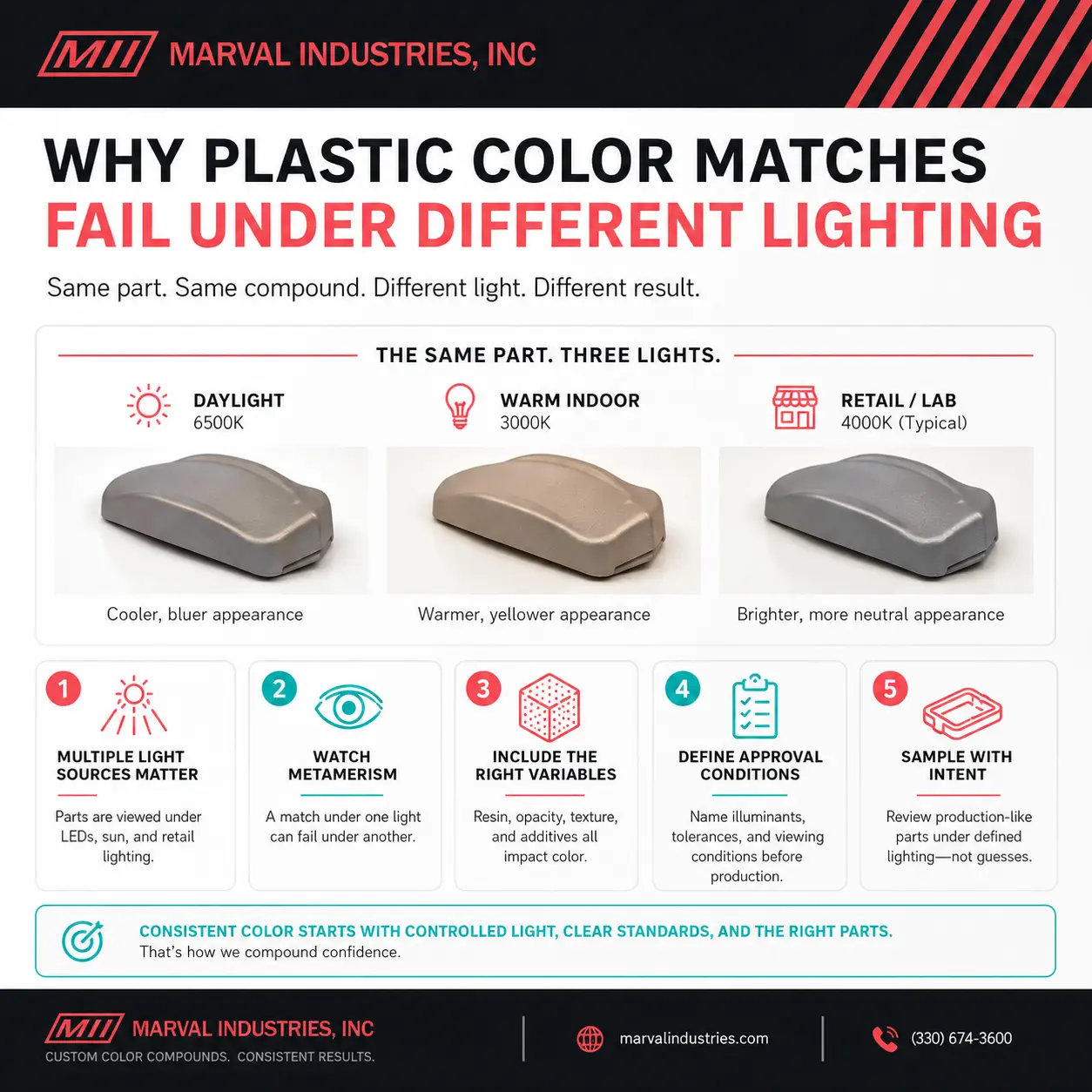
Before approving a plastic color match, buyers should define where and how the part will be judged. A chip match under one booth setting is not enough if the product will sit under retail LEDs, near a window, in a warehouse, on a vehicle, or outside in changing daylight. Color compounding decisions become more reliable when approval conditions reflect real use.
| Approval Factor | What Buyers Should Define | Why It Matters |
| Primary illuminant | The main light source where the product will be viewed, such as LED, fluorescent, daylight, or retail lighting | Sets the main approval condition |
| Secondary illuminants | Other environments where the part must still look acceptable | Reduces surprise color shifts after approval |
| Indoor or outdoor use | Whether the part sees daylight, UV, weather, or changing sun angles | Helps account for exposure and visual shift |
| Retail environment | Shelf lighting, display cases, mixed LEDs, and nearby products | Reflects how customers will see the product |
| Viewing angle and distance | How close the viewer is and from what angle the part is seen | Accounts for gloss, curvature, and surface effects |
| Resin and substrate | Base polymer, natural resin tone, filler package, and opacity | Controls how the colorant appears in the final part |
| Part geometry | Wall thickness, ribs, corners, curves, and flat surfaces | Reveals color differences that plaques may hide |
| Pass/fail method | Visual review, instrument readings, tolerances, or customer approval steps | Prevents subjective disagreement late in the process |
A practical color specification should name the illuminants and the approval method. For example, an appliance trim part may need review under cool white LED and daylight, while a retail package may need evaluation under store lighting first. When plastic color concentrates are judged this way, the approval target becomes the end-use appearance rather than a single lab condition.
Plastic colorants do not perform in isolation. The same pigment system can look different when used in different base resins, wall thicknesses, textures, or processing conditions. That means buyers should not treat color approval as a formula-only decision.
The base resin can affect the final color because natural resin tone, clarity, opacity, filler content, and additives all influence the way light moves through or reflects from the molded part. A translucent material may reveal depth, flow, or wall-thickness variation differently than an opaque resin. A filled compound may mute or shift color compared with an unfilled version of the same polymer family.
Part design can also change the visual result. Thin walls, heavy sections, ribs, edges, corners, and large flat surfaces can all show color differently. Texture and gloss add another layer because a high-gloss surface reflects light differently than a matte or grained surface.
This is why production-intent samples matter. A molded plaque can help during development, but it should not replace review of the actual part when color is critical. The closer the approval sample is to the final resin, tooling, surface, and process, the more useful the color decision becomes.
The best way to reduce metamerism risk is to build real viewing conditions into the approval plan early. Buyers should tell the color compounder how the part will be used, where it will be seen, what material system is involved, and which lighting conditions matter most. That information helps the supplier develop a colorant or compound tailored to the actual application rather than a limited lab target.
| Step | What to Do | What It Prevents |
| Share the end-use environment | Explain where the part will be viewed, sold, installed, or used | Prevents approval under the wrong lighting condition |
| Provide the target standard | Send the approved chip, plaque, sample, or customer standard | Gives the supplier a clear comparison point |
| Identify the resin system | Confirm the base resin, filler, additives, opacity, and processing method | Reduces mismatch between formula and final part |
| Define required illuminants | List primary and secondary lighting conditions | Helps identify metamerism before production |
| Review production-intent samples | Evaluate molded parts, not only plaques or chips | Shows the real effect of geometry, texture, and wall thickness |
| Document pass/fail criteria | Set visual and instrument-based approval requirements | Reduces disagreement between teams |
| Confirm change control | Require review before resin, pigment, supplier, or process changes | Protects consistency after approval |
A controlled color approval process gives purchasing, engineering, quality, and marketing teams the same basis for decision-making. It also helps prevent late-stage disputes over whether a part is “right” or “wrong” when the real issue is that the approval conditions were incomplete. When color matters to brand perception, customer acceptance, or product quality, those conditions should be defined before production release.
A successful color compounding program does more than match a chip in one controlled setting. It accounts for the resin, colorant package, processing method, part geometry, surface character, and lighting conditions that shape the finished part’s real appearance. When buyers define those conditions early, they reduce the risk of lab-approved colors becoming shelf, field, or customer problems. Bring Marval Industries into the color development process before production approval so your team can align the compound, color standard, viewing conditions, and performance expectations with how the part will actually be seen.
315 Hoyt Ave Mamaroneck NY 10543
customerservice@marvalindustries.com
customerservice@marvalindustries.com
(914) 381-2400


