


Phone: (914) 381-2400E-Mail: customerservice@marvalindustries.com
Medical device manufacturers should evaluate plastic resin suppliers based on their ability to provide the specified material consistently throughout production. An attractive price or immediate availability may justify considering a supplier, but neither establishes that its materials, documentation, and delivery arrangements meet the manufacturer's requirements.
The distinction becomes more important when sourcing resin for an established medical product. Once a manufacturer has selected a material and incorporated it into production, changing suppliers or accepting an alternative formulation may require additional evaluation.
At Marval Industries, we distribute plastic resins and provide color matching and custom compounding services. We recommend evaluating potential suppliers against the existing material specification and anticipated production requirements before comparing quotations.
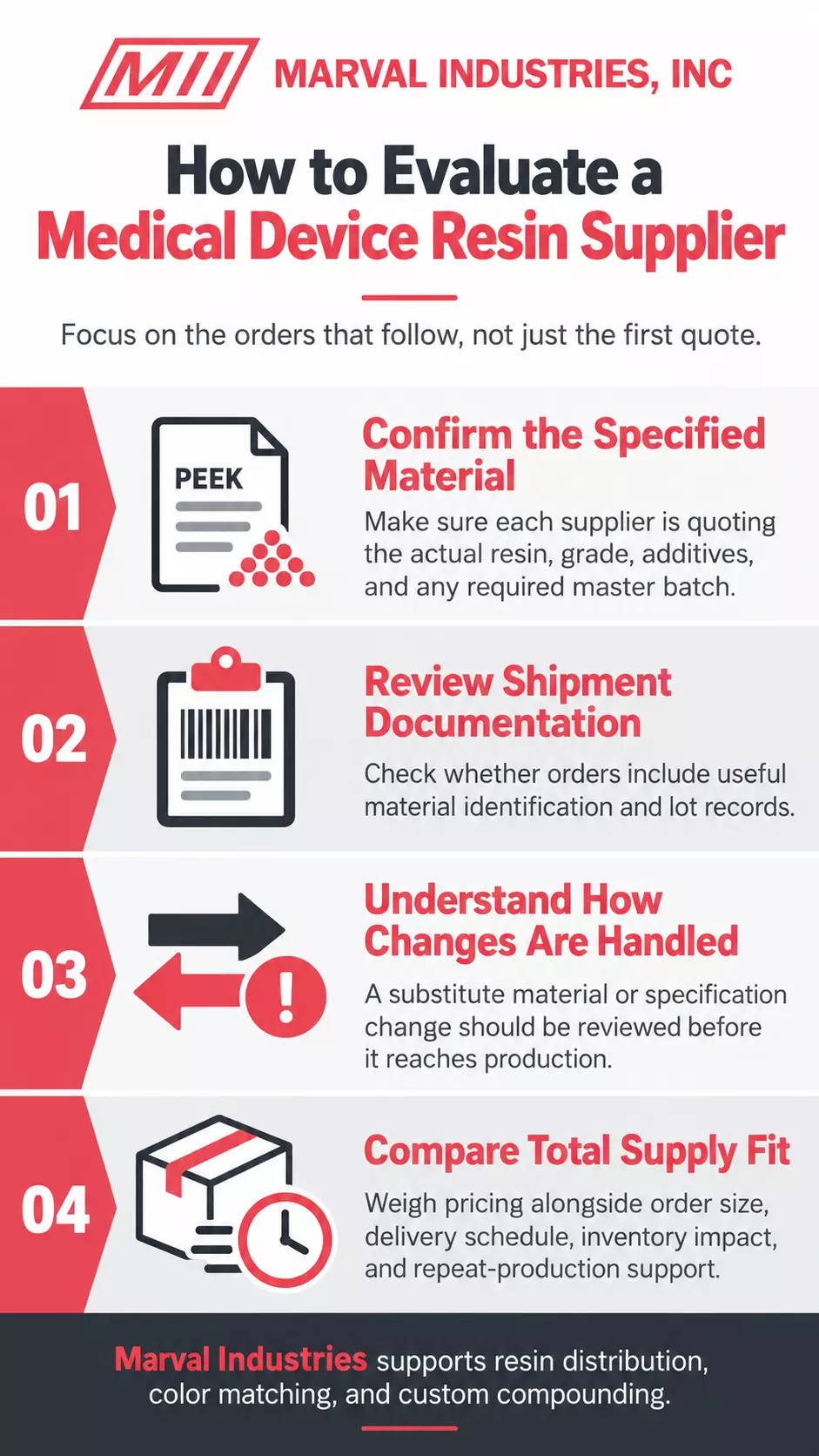
The first question in a supplier comparison is whether every quotation covers the same material.
Two companies may supply polypropylene, polycarbonate, or another polymer family without offering identical resin grades. Differences in additives, processing characteristics, or formulation can matter even when the materials share a general description.
For an established medical product, the manufacturer's material specification should identify the requirements against which each offer is evaluated. These may include the resin manufacturer and grade, relevant material characteristics, color requirements, or a particular additive formulation.
If the application uses a specified color concentrate, its identity and compatibility should also be part of the purchasing discussion. A supplier offering a different concentrate is proposing a potential formulation change, not necessarily an interchangeable replacement.
The U.S. Food and Drug Administration (FDA) provides an important distinction in its biocompatibility guidance. The agency explains that it evaluates medical devices in their final finished form rather than approving individual raw materials for unrestricted use in medical devices.
For purchasing teams, this means descriptions such as medical-grade plastic do not establish that a resin is appropriate for every application. A supplier's quotation should clearly identify the proposed material so the manufacturer can compare it with the specifications required for its product.
Can the Supplier Document What Arrives With Each Order?
After confirming the material, manufacturers should examine how the supplier identifies and documents individual shipments.
A supplier-selection guide published through the National Institute of Standards and Technology's Manufacturing Extension Partnership recommends reviewing production and inspection records, including lot control. The guidance emphasizes that manufacturers need information that allows them to investigate a problem rather than relying solely on assurances about product quality.
For resin purchasing, material identification becomes useful when comparing production runs or investigating unexpected differences in finished components.
Suppose a manufacturer produces molded parts using resin received in two separate shipments. An unexpected difference appears during the second run. Records connecting each shipment to its material grade and lot can help determine whether a material change is among the factors requiring investigation.
That information does not prove the resin caused the problem. Processing conditions, equipment settings, and other manufacturing variables may also influence the result. However, identifying the material used in each run helps narrow the investigation.
Manufacturers should determine which shipment records are available and whether those documents meet their purchasing and quality requirements. Depending on the application, relevant records may include material identification, lot information, certificates of analysis, or other supporting documentation.
The objective is to obtain information the manufacturer can use, not documentation for its own sake.
Even a supplier that consistently fills orders may encounter changes in material availability. A specified grade may become difficult to obtain, or another formulation may be proposed as an alternative.
These situations create a purchasing decision that should be distinguished from a routine reorder.
In its guidance on material and component documentation, the FDA explains that changes in raw-material suppliers or specifications can introduce different types or quantities of residual chemicals. Depending on the material and finished-device application, such differences may affect the information needed for a biocompatibility assessment.
The guidance does not establish that every resin substitution is unsafe or automatically requires new testing. It does, however, explain why two materials with similar descriptions should not be presumed identical.
For medical device manufacturers, the purchasing implication is clear. A proposed substitution should be identified before it enters production so the manufacturer can determine whether additional evaluation is necessary.
When reviewing suppliers, manufacturers should understand how potential substitutions are communicated, what information can be provided about alternative materials, and how known specification changes are handled.
Once potential suppliers can meet the specified material requirements, pricing becomes a more meaningful basis for comparison.
The initial quotation may not reflect the complete cost of purchasing and maintaining a resin supply. Freight, minimum order quantities, delivery frequency, and inventory requirements can affect the overall expense.
NIST's supplier-selection guidance encourages manufacturers to evaluate total cost of ownership rather than relying exclusively on the unit price. This approach considers how a supplier's products and arrangements affect costs elsewhere in the manufacturing operation.
Consider two suppliers quoting the same specified resin. One offers a lower price per pound but requires large minimum orders. The other offers smaller shipments at a higher unit price.
The first arrangement may be more economical for a manufacturer with sufficient storage capacity and predictable consumption. The second may better suit an operation that needs to limit inventory or coordinate deliveries with shorter production schedules.
Neither supplier is automatically preferable.
Purchasing teams should compare quotations using the same anticipated production volumes, order frequency, freight arrangements, and documentation requirements. Where a proposed alternative involves a different resin or formulation, any necessary evaluation should remain separate from the apparent purchasing savings.
A supplier's ability to fulfill the first order does not establish how well it can support a product that remains in production for several years.
Manufacturers need to consider anticipated demand, delivery schedules, and how material availability will be managed over repeated purchases. A supplier may have suitable material available today without being able to confirm the same arrangements for future orders.
NIST's manufacturing guidance identifies supplier capacity, equipment, staffing, and logistics as considerations in supplier selection. These factors help buyers evaluate whether a supplier's operating arrangements fit their own production requirements.
For resin buyers, the most relevant questions concern expected order quantities, lead times, delivery capabilities, and communication when availability changes.
The type of material being purchased also influences the relationship. A manufacturer sourcing an established commercial resin may primarily need distribution and delivery support. A project requiring a specialized formulation may involve additional considerations, including color development, compounding capabilities, and ongoing availability of the finished material.
Marval Industries provides resin distribution alongside color matching and custom compounding. Our resin distribution capabilities include bulk material handling and just-in-time delivery services, while our compounding operations support manufacturers with more specialized material requirements.
The appropriate supplier arrangement depends on which of those services the manufacturer actually needs.
The most suitable plastic resin supplier is one whose materials, documentation, and commercial arrangements support the manufacturer's established production requirements. Once buyers confirm that a supplier can provide the specified material and appropriate supporting information, they can compare pricing and delivery terms without overlooking differences that may affect production.
For medical device manufacturers considering Marval Industries, the starting point is an established resin specification and anticipated purchasing volume. Those details allow us to evaluate available distribution and compounding options and determine whether our services are a suitable match for the application.
315 Hoyt Ave Mamaroneck NY 10543
customerservice@marvalindustries.com
customerservice@marvalindustries.com
(914) 381-2400


