


Phone: (914) 381-2400E-Mail: customerservice@marvalindustries.com
A custom compound can fail before the first pellet reaches a molding machine or extruder. The issue is often not effort, but a mismatch between formulation assumptions and production reality. A resin that appears correct on paper can process poorly when screw design, residence time, melt temperature, tooling restrictions, color target, regrind level, or end-use exposure were never defined.
Plastic resin suppliers need production data before formulating a custom compound because the material must perform inside a real process, in a real part, under real commercial expectations. Marval Industries uses that information to align base resin, additives, fillers, colorants, processing aids, and compliance needs with the manufacturer’s equipment and performance goals. The essential data includes the intended process, equipment limits, operating conditions, finished-part requirements, regulatory obligations, and current material history.
The first formulation constraint is the manufacturing method. A compound for injection molding may need different flow, shear tolerance, and cooling behavior than one built for extrusion, blow molding, profile work, or compression molding. The process defines how the material will experience heat, pressure, residence time, tooling restriction, and downstream handling.
Equipment details help plastic resin suppliers formulate for the production floor rather than an ideal laboratory condition. Machine size, barrel capacity, shot size, extruder diameter, L/D ratio, die style, venting, and feeder setup can all influence resin selection and additive balance. Screw design is especially useful when compression ratio, mixing elements, barrier design, or venting may affect dispersion, degradation risk, or melt stability.
Tooling details often explain why two applications using the same resin family behave differently. Thin walls, long flow paths, small gates, tight dies, or high-polish surfaces may require a narrower processing window than a simpler geometry. Sharing these constraints early helps the compound target the actual conversion environment instead of relying on broad datasheet assumptions.
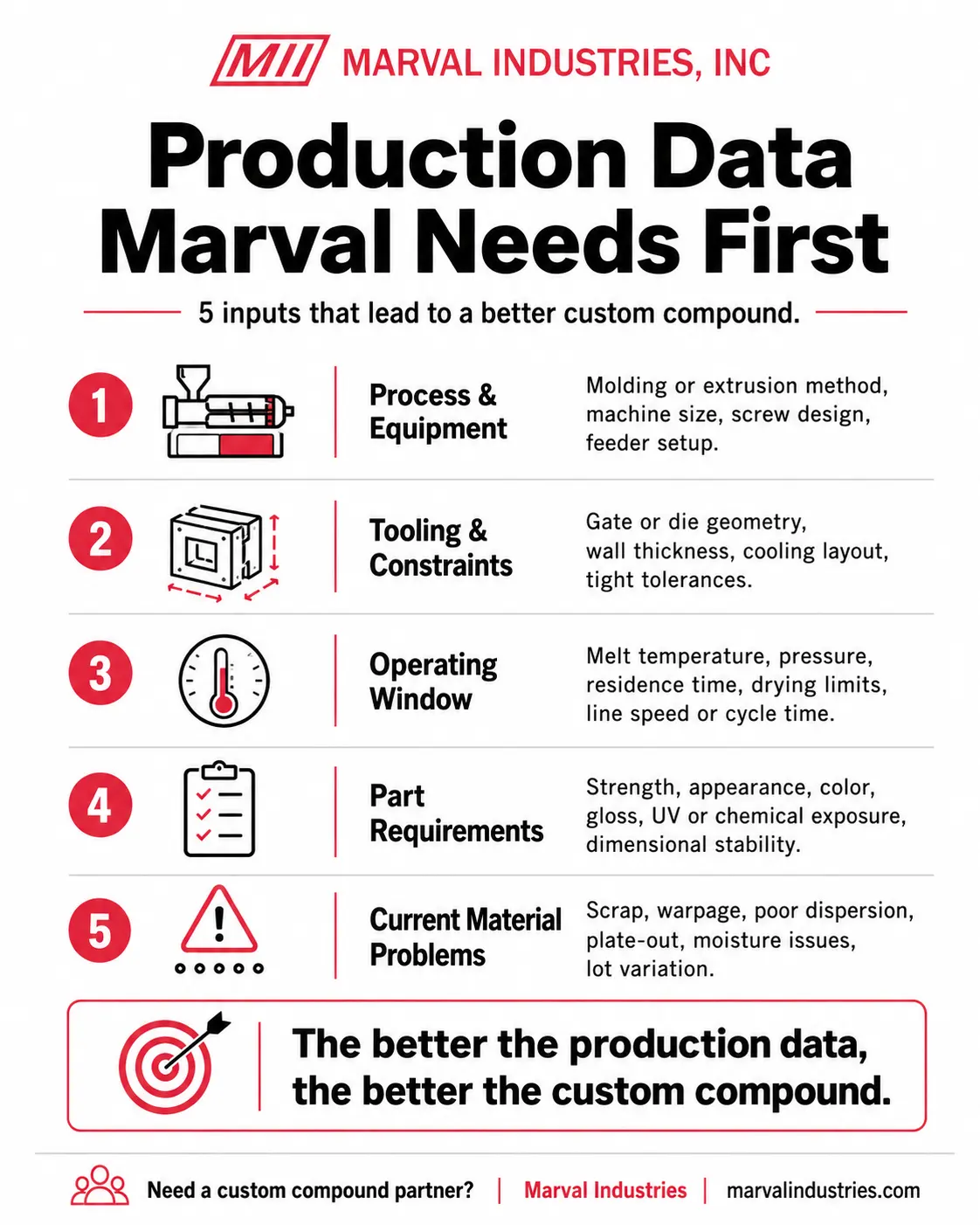
A custom compound should be built around the actual production window. Melt temperature, mold or die temperature, cycle time, line speed, residence time, and pressure range all affect how the material should be stabilized and modified. When these values are unknown or treated as flexible, the processor may be forced to correct formulation issues at the machine.
Production factor | Why it matters for custom compounding |
Melt and zone temperatures | Indicates thermal exposure, degradation risk, and stabilizer needs |
Cycle time or line speed | Affects cooling, crystallization, output stability, and release behavior |
Residence time and shear | Helps predict discoloration, breakdown, dispersion, and viscosity changes |
Pressure and flow limits | Guides melt-flow targets, filler loading, and processing-aid selection |
Drying and moisture control | Determines whether moisture sensitivity or handling limits must be designed around |
Production history matters as much as machine settings. Recurring splay, sink, warpage, die buildup, poor release, burning, color variation, brittleness, or unstable output can reveal what the compound must tolerate. Those symptoms may point toward changes in base resin, filler level, lubricant package, stabilizer system, colorant compatibility, or moisture-control strategy.
Drying limitations should also be part of the formulation discussion. Some compounds are more sensitive to retained moisture, inconsistent hopper residence time, long conveying distances, or fluctuating regrind than others. A realistic view of material handling helps prevent a formulation from depending on preconditioning steps that the production floor cannot consistently support.
The finished part defines the second major design constraint. A flexible grip, rigid housing, chemical-resistant component, and outdoor enclosure can require very different balances of stiffness, impact strength, elongation, heat stability, color control, and surface appearance. Dimensional expectations also matter because shrinkage, warpage sensitivity, wall thickness, tolerance range, and mating-part geometry can determine how much the formulation should prioritize stability over flow or toughness.
Useful specifications connect a property to the actual application. “Good impact” is less helpful than a defined drop condition, low-temperature exposure, assembly load, or vibration requirement. “Smooth black finish” is clearer when gloss, texture, opacity, flow-line visibility, and color-match expectations are defined.
Regulatory and market-entry requirements should be known before formulation work begins. Additives, colorants, fillers, and base resin choices can affect whether a technically successful compound is acceptable for the intended supply chain. The publication Compliance Certifications identifies REACH compliance with European Union regulation EC 1907/2006 for substances of very high concern. It also identifies RoHS 2 under EU Directive 2011/65/EU, which restricts hazardous substances in electrical and electronic equipment. RoHS 3 under EU Directive 2015/863/EU adds phthalate restrictions that may affect material selection. The same source notes that 3-A Dairy criteria for multiple-use product-contact surfaces include cleanability, bacterial treatment, repeat-use conditions, and FDA compliance. Early compliance screening helps Marval avoid sample paths that fail to meet documentation or end-use requirements.
The current material is often the best starting point for a custom compound. A technical data sheet, safety data sheet, certificate of analysis, prior specification, color standard, or process note can establish a useful baseline. Even when the existing grade is failing, it can reveal what is already close to target and what must change.
The most important details explain where the current material breaks down under production conditions. Flash, plate-out, warpage, streaking, impact failure, scrap rate, feed inconsistency, moisture sensitivity, and dimensional drift all point toward different formulation decisions. Without that history, development becomes more dependent on trial sampling and less connected to the real production issue.
Production history also helps separate a material problem from a processing problem. A defect that appears after a tool change, drying deviation, or regrind increase may call for a different correction than one that appears across machines and operators. Connecting plant-floor evidence with compounding decisions helps the next sample address the known constraint rather than simply replacing the current grade.
Custom compounding depends on accurate production data because a resin formulation can only perform reliably when it is built around the equipment, operating window, and finished-part demands it will actually face. Machine type, screw design, melt temperature, drying practice, cycle expectation, tooling constraints, wall thickness, color requirements, compliance targets, and known defect history all help define the right formulation path. Sharing process details with Marval Industries supports a more focused compound recommendation, fewer avoidable trials, and a stronger path from sample approval to repeatable production.
315 Hoyt Ave Mamaroneck NY 10543
customerservice@marvalindustries.com
customerservice@marvalindustries.com
(914) 381-2400


