


Phone: (914) 381-2400E-Mail: customerservice@marvalindustries.com
Changing plastic resin suppliers during an active OEM program is rarely a simple purchasing decision. A resin substitution might address a supply shortage, improve availability, or reduce material costs, but it can also affect molding behavior, assembly fit, regulatory compliance, and long-term product performance. Before approving any material change, sourcing, engineering, quality, and operations, teams should ask questions that identify technical and production risks before they disrupt manufacturing.
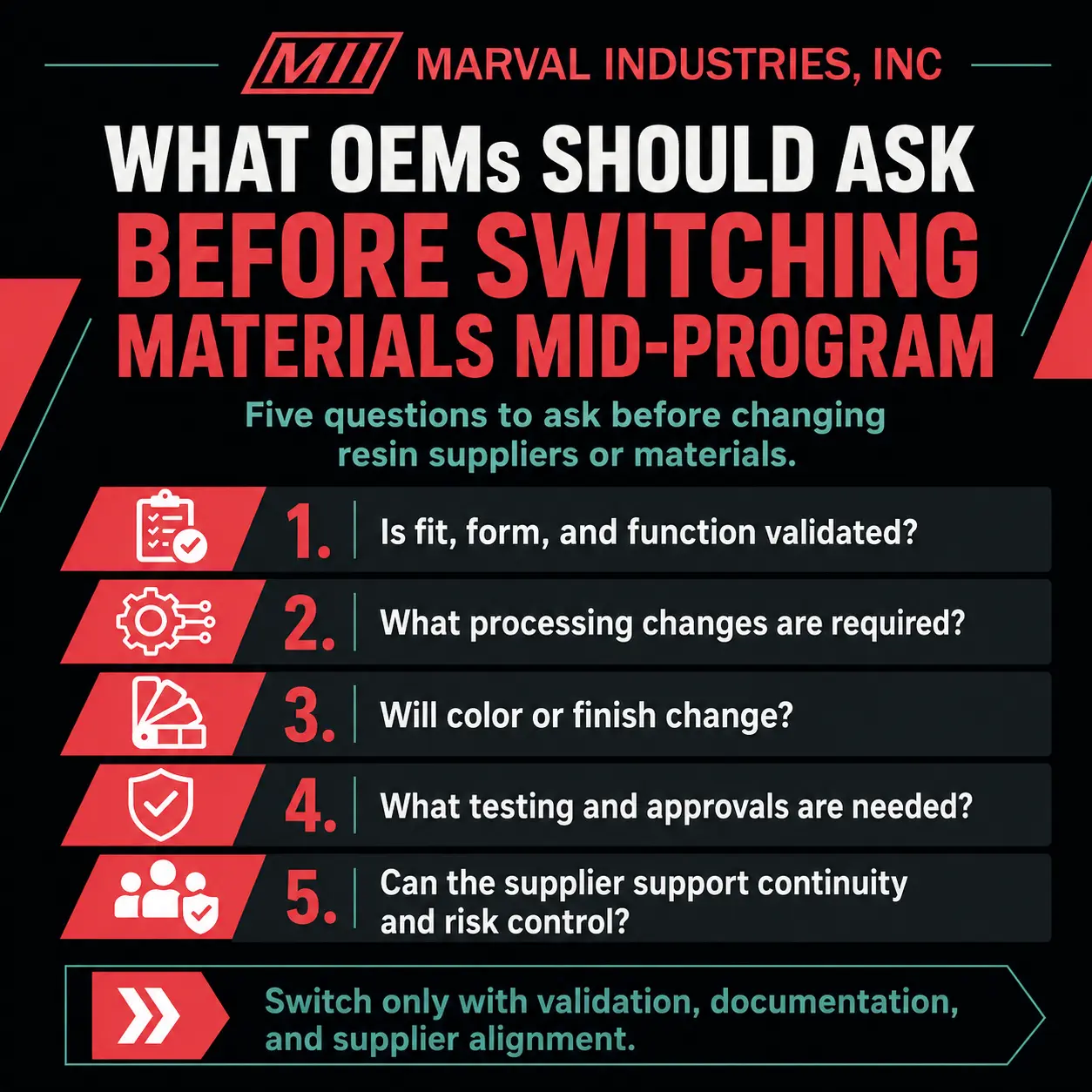
Will the replacement meet the original material specification and application requirements? Can the supplier document regulatory, safety, and quality compliance? What validation is required before production approval? How will lead times, allocations, and lot consistency be managed? Who provides technical support if molding performance changes after implementation? These questions help determine whether the proposed resin is a qualified replacement or an unnecessary production risk.
For OEMs, the primary concern is not whether another resin exists. The real question is whether the proposed substitute can be qualified without creating unacceptable risk to the part, customer, production program, or delivery schedule. Mid-program plastic resin changes become risky when treated as purchasing substitutions rather than engineering-controlled changes.
Every molded component is developed around a specific combination of material, tooling, processing conditions, and approval history. Even if a replacement resin fills the mold successfully, subtle differences may affect assembly, appearance, durability, or field performance. These concerns become even more significant for safety-critical, regulated, customer-facing, or difficult-to-rework components.
A qualified supplier should explain how the proposed resin performs under the application's actual operating conditions. A generic material data sheet supports the evaluation, but application-specific engineering judgment remains essential. Molders should also participate early, as molding trials often reveal differences that property comparisons alone do not detect.
A replacement resin should always be evaluated against the approved design intent instead of simply comparing trade names. OEM teams should verify which specification the new grade meets and identify all technical differences before approval. If drawings, bills of materials, customer approvals, or internal standards reference a specific resin grade, the proposed material should be clearly identified as an equivalent, comparable alternative, or a true drop-in replacement.
The first technical review determines whether the replacement material meets all approved requirements. Important comparisons include:
| Property | Why It Matters |
| Resin family | Confirms material compatibility |
| Melt flow rate | Influences molding consistency |
| Impact strength | Affects durability under load |
| Tensile properties | Determines structural performance |
| Heat resistance | Verifies operating temperature capability |
| Shrinkage | Impacts dimensional accuracy |
| Filler content | Changes stiffness and processing behavior |
| Flame rating | Supports regulatory compliance |
| Agency listings | Maintains certifications and approvals |
Shortage-driven substitutions deserve additional scrutiny because materials with similar published properties often behave differently in production.
Some differences are acceptable if validation confirms adequate performance. Others require customer approval, tooling adjustments, regulatory review, or complete rejection before production trials begin. The objective is identifying those issues before production depends on an unqualified material.
Processing behavior deserves the same level of evaluation as published material properties. A resin that appears suitable on paper might perform differently in production if its viscosity, moisture sensitivity, crystallinity, lubrication, or thermal stability differs from those of the incumbent grade. OEM teams should request realistic molding recommendations and document every processing adjustment before approving production use.
Application-specific performance should guide the final review because different molded products fail in different ways. Cosmetic housings, fluid-contact components, living hinges, snap-fit assemblies, and safety-related parts each present unique performance requirements. Suppliers should explain how the proposed resin performs within the actual service environment rather than relying on general substitution claims.
A mid-program resin change requires substantially more than a quotation and delivery date. Plastic resin suppliers should provide documentation that enables engineering, quality, purchasing, and regulatory teams to evaluate the proposed material without searching for missing information.
The replacement material should move through existing quality systems with complete traceability from approval through production.
| Documentation | Purpose |
| Material data sheet | Verifies technical properties |
| Regulatory declarations | Confirms compliance requirements |
| Quality certifications | Supports supplier qualification |
| Lot traceability | Tracks production history |
| Change control documentation | Prevents undocumented formulation changes |
| Agency approvals | Maintains certification status |
Traceability becomes especially important during material changes in production. OEMs should be able to connect every molding trial, approved component, and production shipment to documented lot history.
The strongest suppliers explain how every document reduces production risk. They also identify any missing information, including pending regulatory declarations, incomplete color matching, or unavailable agency approvals. This transparency allows OEMs to make informed decisions before customer audits or shipment issues expose documentation gaps.
Validation should begin with controlled production trials instead of immediate plant-wide conversion. Suppliers should provide sample quantities from the intended production grade, while molders perform documented trials under normal operating conditions.
Processing variables such as:
should all be recorded because relatively small adjustments often influence production repeatability.
First article inspections alone rarely provide sufficient evidence for a mid-program resin change. Early production parts might appear acceptable, but dimensional variation, cosmetic issues, or assembly problems may emerge after the process stabilizes. OEM teams should establish approval criteria before testing begins so engineering, quality, manufacturing, and customers evaluate identical performance requirements.
Customer approval requirements also need clarification before shipment begins. Some programs require notification only, while others require formal approval, PPAP documentation, engineering deviations, revised drawings, or updated regulatory submissions. Maintaining controlled inventory during validation helps protect deliveries while qualification activities are completed.
A resin substitution might be justified when the incumbent material becomes unavailable, supply stability improves significantly, or cost pressures threaten production continuity. It becomes difficult to justify when customer approval timelines, validation requirements, or technical uncertainty outweigh those benefits.
| Evaluation Area | Key Consideration |
| Technical performance | Does the replacement perform as required? |
| Production risk | Will manufacturing remain stable? |
| Commercial impact | Does the financial benefit outweigh qualification costs? |
| Customer obligations | Are approval requirements satisfied? |
Material cost alone should never drive the final decision. Lower resin pricing quickly loses value if the substitution creates scrap, additional inspections, delayed approvals, requalification expenses, or field failures.
A resin switch becomes more attractive when it protects production continuity without introducing unknown product behavior. It becomes less attractive when documentation is incomplete, customer approvals are uncertain, or validation takes longer than the supply shortage allows. When significant risks remain unresolved, bridge buys, controlled deviations, or alternate sourcing strategies often provide safer short-term solutions.
Switching plastic resin suppliers mid-program can protect production continuity, stabilize supply, and control material costs, but only when OEMs manage the change as an engineering decision rather than a purchasing shortcut. The substitute must match the approved specification, fit the real application, process consistently, include complete documentation, and pass validation before production release.
Those steps help sourcing, engineering, quality, and operations teams see risk before the material reaches the press, the assembly line, or the customer. A resin change becomes safer when the supplier can explain what is equivalent, what is different, what requires approval, and what evidence supports the switch.
Marval Industries helps OEM teams compare material options, review documentation, coordinate supplier requirements, and move from resin selection to production approval with control. Bring Marval into the conversation early so your team has a practical resin partner before a shortage, cost issue, or material change becomes a production problem.
315 Hoyt Ave Mamaroneck NY 10543
customerservice@marvalindustries.com
customerservice@marvalindustries.com
(914) 381-2400


