


Phone: (914) 381-2400E-Mail: customerservice@marvalindustries.com
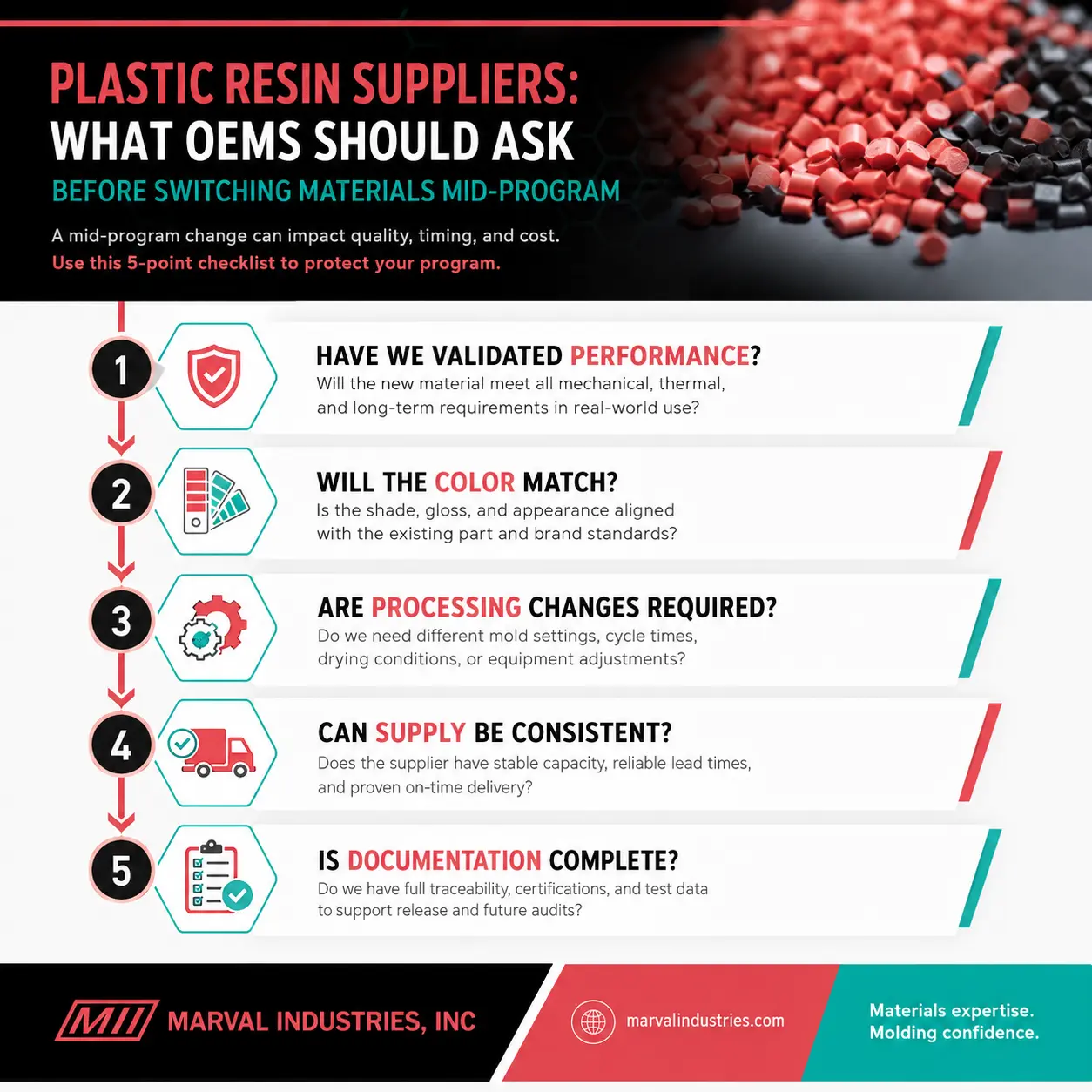
A finished plastic product starts as a material decision long before it becomes a package, housing, display, tube, film, container, or molded component. When a production run shows streaks, color drift, warping, weak appearance, brittle performance, static problems, or inconsistent lots, the visible defect often points to an earlier material issue. The problem may start with the way resin, colorant, additive package, process, and end use were matched before production. A plastic resin supplier helps control those decisions before they become scrap, downtime, rejected parts, or missed delivery dates.
A plastic resin supplier provides the raw plastic materials manufacturers use to make finished products. That includes base resins, color masterbatch, additives, specialty compounds, custom formulations, and processing support. Marval works in that role with colorants, additives, compounds, and resins for injection molding, extrusion, blown film extrusion, blow molding, rotational molding, and thermoforming. The main question is not only where a manufacturer buys resin. The better question is how the supplier helps the manufacturer obtain material that runs correctly, meets the product requirements, and remains consistent throughout production.
A plastic resin supplier provides the material before a finished plastic product exists. The material may arrive as pellets, powders, compounds, concentrates, blends, or a custom formulation. One customer may need prime resin for a production run. Another may need a color concentrate, an additive package, a specialty compound, or outside processing support before the material reaches the machine. The supplier’s role depends on what the customer is making and what the finished product needs to do.
Resin supply starts with the base polymer, but it does not end there. A buyer asking for polypropylene, nylon, ABS, polycarbonate, acetal, acrylic, polyurethane, or SAN is naming a material family, not the whole production requirement. Material selection must account for performance, aesthetics, cost, product lifetime, and, sometimes, regulatory requirements. That matters because a material that looks right on a quote still has to melt, flow, color, form, cool, release, and perform in the finished application. The supplier helps connect the resin name to the manufacturing reality.
A resin supplier may also provide color and additives that shape how the material looks, how it is processed, and how it performs. Color masterbatch is not separate from the resin decision once production starts, because the carrier resin, pigment, dosage, and base polymer must work together in the machine. Peer-reviewed polymer research shows that processing parameters and additive combinations can affect pigment dispersion and color deviation. That supports what manufacturers see when color problems appear as streaks, specks, color shift, or inconsistent output. The color issue may look cosmetic, but the cause often sits inside the material system.
Marval’s supplier role belongs in that material system, not in a single product bucket. Resin distribution, color masterbatch, specialty compounding, anti-static polymers, eco-friendly resins, and toll processing all answer different versions of the same production need. The customer is not only asking for plastic. The customer is requesting material that meets the machine, part, appearance standard, use environment, and production schedule requirements.
Resin moves from supplier to manufacturer as part of a production chain. The supplier sources, prepares, compounds, colors, packages, ships, or processes material before the customer turns it into a finished product. The manufacturer then melts, molds, extrudes, blows, forms, or otherwise processes that material into parts, packaging, film, containers, housings, displays, or other goods. The supplier’s work matters because every material decision becomes part of the customer’s production process.
The movement is not always a simple warehouse shipment. Some customers buy resin and run it with their own color concentrate. Others need the resin and color package supplied together. Some need a custom compound before the material reaches production, while others need toll processing because they do not want to add equipment, labor, permits, or floor space. Marval’s toll processing services support compounded materials for trial runs and commercial production without requiring the customer to make a large capital investment. That becomes important when the customer needs to test, scale, or stabilize a material before committing to internal processing capacity.
A supplier also helps reduce friction between purchasing and production. Purchasing may focus on availability, price, lead time, and delivery. Engineering may care about flow, impact, clarity, stiffness, electrical behavior, or regulatory fit. Production may care about drying, blending, cycle time, color consistency, and scrap. Quality may care about repeatability, documentation, lot control, and customer acceptance. The resin supplier sits near the front of that chain, where small material decisions can have a large impact on production.
Supplier step |
Manufacturing impact |
Resin sourcing |
Helps secure the base material for the production run |
Color or additive matching |
Helps the material meet appearance, processing, or performance needs |
Custom compounding |
Reduces machine-side variables by integrating material components before production |
Toll processing |
Gives manufacturers outside processing capacity for trials or commercial runs |
Shipping and delivery coordination |
Helps production stay supplied and reduce avoidable downtime |
Resin movement also includes information movement. A supplier needs to understand what the manufacturer is making, how the material will perform, the required performance, and the conditions the finished product will face. Without that context, the supplier can ship material, but cannot fully support the production goal. The strongest supplier relationships pair material availability with sufficient technical information to avoid preventable failures. That is how resin supply becomes part of manufacturing support.
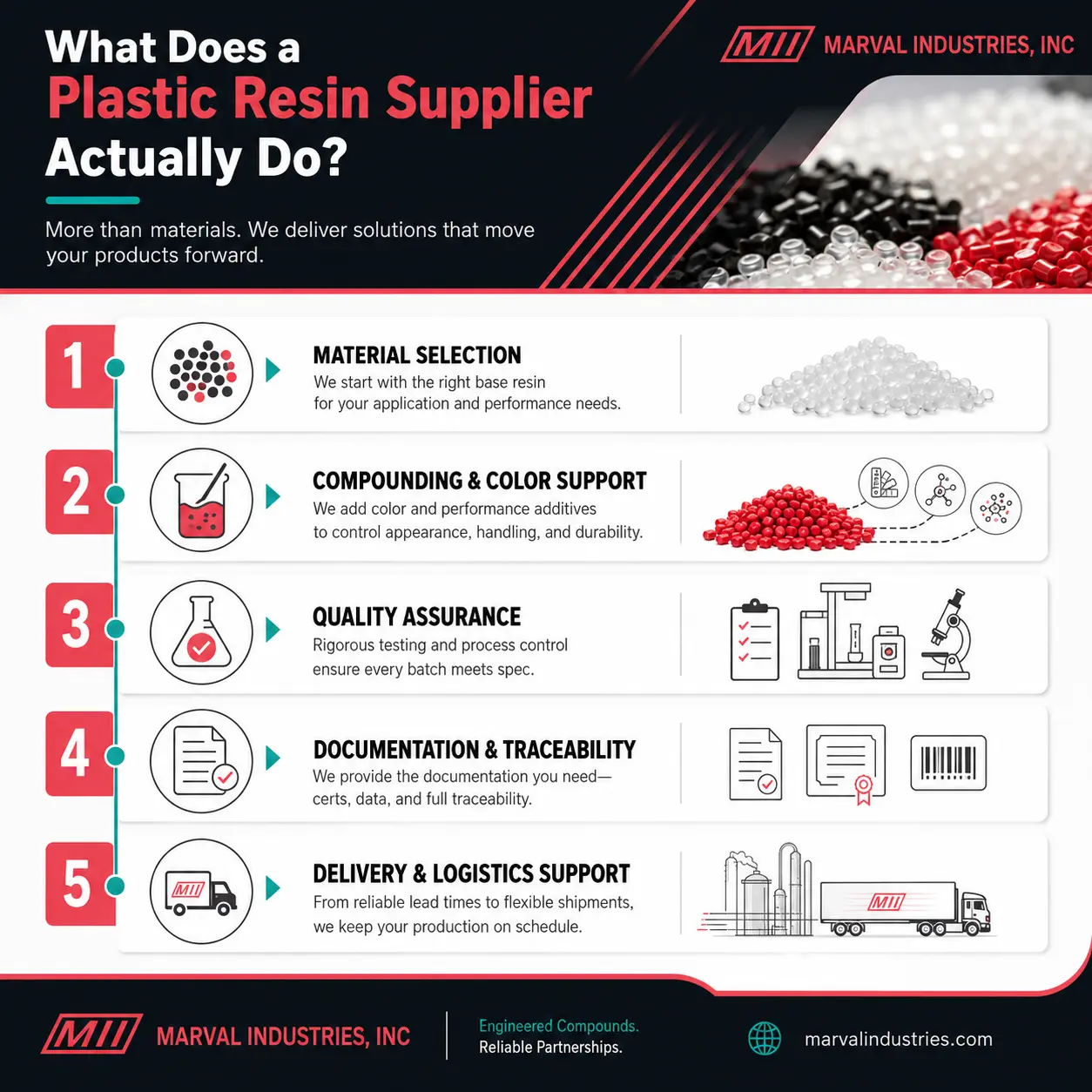
Plastic resin suppliers often do more than sell base resin. They help manufacturers control color, additives, custom formulations, processing needs, and documentation-sensitive requirements. That work matters because the finished product does not care whether a problem came from purchasing, engineering, production, or quality. If the material does not run or perform correctly, the plant still deals with downtime, scrap, rejected output, or customer complaints.
Color support is one of the clearest examples. Color is usually added before or during melt processing so pigment, carrier resin, additives, and base polymer can disperse under heat and shear. Processing parameters affect pigment dispersion and color deviation in compounded polymer systems. That matters because poor color can signal more than a visual mismatch. The issue may involve carrier compatibility, concentration, screw behavior, temperature, additive interaction, or the way the material was prepared before production.
Custom compounding answers a different need. A customer may need more stiffness, clarity, impact resistance, conductivity, wear resistance, color control, or processing stability than a base resin provides on its own. Specialty compounding integrates fillers, reinforcements, additives, polymer blends, and colorants into a more controlled material. Marval positions specialty compounding around mechanical, thermal, and functional requirements rather than solely on color. That matters because some production problems require a material tailored to the application, not a stock resin with a machine-side adjustment.
Suppliers also support regulated or documentation-sensitive products. Food-contact applications require more careful material discussions because packaging components, processing equipment, preparation surfaces, cookware, adhesives, colorants, certain antimicrobial uses, and antioxidants may fall under the FDA’s food-contact framework when they contact food under defined conditions. Substances that qualify as food additives in food-contact use need authorization through a food contact notification, food additive regulation, or Threshold of Regulation exemption. That means resin, color, and additive decisions should account for intended use before production begins. The supplier helps make sure the material conversation starts with the right questions.
A supplier does not replace the manufacturer’s engineering team, production team, or regulatory responsibility. The supplier helps those teams make better material decisions earlier. That is the value behind resin distribution, color masterbatch, compounding, and toll processing. The supplier helps reduce the gap between a material order and a material that works in production.
A resin supplier needs to understand the manufacturing process because resin does not perform in isolation. It performs under heat, pressure, shear, residence time, cooling, drying, blending, handling, and inspection. Injection molding, extrusion, blown film extrusion, blow molding, rotational molding, and thermoforming each place different demands on the material. A resin, color package, or compound that works in one process may not behave the same way in another.
The process changes how the supplier should think about the material. In injection molding, the material has to melt, flow into the mold, pack, cool, release, and hold the required appearance and dimensions. In extrusion, the material has to move through the screw and die with stable flow, dispersion, and output. In blown film, the material has to support film strength, gauge control, and appearance. A supplier that understands the process can ask better questions before recommending resin, color, additives, or compounding.
Material selection also has to reflect the finished product’s use environment. Performance, cosmetics, cost, lifetime, and regulatory conditions all shape whether a material is appropriate. That is why the same resin family can lead to different supplier conversations depending on the part. A packaging application, display component, industrial housing, film product, or technical molded part may need different color control, additive support, impact strength, clarity, stiffness, or documentation.
Process knowledge also helps suppliers understand production problems when they appear. Streaks may point to dispersion, contamination, incompatibility, or machine settings. Warping may point to material behavior, design, cooling, or processing conditions. Static may indicate a need for anti-static or conductive properties. Color drift may indicate masterbatch dosage, carrier resin, thermal history, or additive interactions. A supplier that understands the process can help narrow the issue instead of treating every problem as a reorder.
This is why manufacturers should not view resin suppliers as interchangeable vendors. The supplier’s role is strongest when material, process, and end use are discussed together. Marval’s work across resin distribution, masterbatch, compounding, anti-static polymers, eco-friendly resins, and toll processing reflects that broader supplier function. The goal is not to make the material conversation more complicated. The goal is to prevent avoidable complications after production starts.
A plastic resin supplier provides the raw plastic materials manufacturers use to make finished products, but its role does not end there. The supplier also helps with color, additives, custom compounds, toll processing, documentation-sensitive requirements, and process fit. The right conversation starts with the product, production process, resin family, color target, performance needs, run volume, and any
documentation requirements. Those details help the supplier connect the material order to the finished product requirement. We at Marval support manufacturers that need resin, color masterbatch, specialty compounding, additives, and processing support tied to production. Contact Marval before a material decision becomes a production problem.
315 Hoyt Ave Mamaroneck NY 10543
customerservice@marvalindustries.com
customerservice@marvalindustries.com
(914) 381-2400


