


Phone: (914) 381-2400E-Mail: customerservice@marvalindustries.com
A resin might look right on a datasheet and still fail on the line. It might warp in the mold, streak during extrusion, miss a color target, build static, lose stiffness, or force constant processing adjustments. For manufacturers, those problems show up as scrap, delays, rejected parts, inconsistent lots, and customer pushback.
Specialty plastic compounding turns a base resin into a material built for the actual part, process, and requirement. At Marval, specialty compounding is not about making plastic more complex. It is about making the material more predictable before it reaches injection molding, extrusion, blown film extrusion, blow molding, rotational molding, or thermoforming.
Specialty plastic compounding begins when the resin, on its own, does not carry out the full job. A resin might be close, but close is not enough when a molded part warps, an extruded profile shows surface problems, color shifts between runs, or a finished product needs documentation for a regulated use. In those situations, the material problem must be resolved before production.
Manufacturers should not treat specialty compounding as a generic mixing service. A compounder is not only adding ingredients to plastic. The compounder helps translate part requirements into a material system built around resin, additives, fillers, reinforcements, color, processing behavior, and final-use expectations.
Manufacturing problem |
Why specialty compounding enters the conversation |
The part lacks stiffness |
Mineral fillers or glass reinforcement might shift rigidity and dimensional behavior. |
The part cracks or fails impact needs |
Toughening, resin blending, or compatibilization needs review. |
Static buildup creates risk |
Anti-static, ESD, or conductive additives might become part of the formulation. |
Outdoor exposure matters |
UV stabilizers and antioxidants might need to be built into the compound. |
Color must stay consistent |
Pigment selection and dispersion need to work with the resin and process. |
Compliance matters |
Additive and resin choices need early screening against customer or regulatory requirements. |
The better first question is not “Which additive should be used?” The better question is “What is the current resin failing to do?” A structural issue, a processing issue, an appearance issue, an electrical issue, and a compliance issue all point to different material decisions.
Specialty compounding changes the base resin by building a targeted property package into the material. That package might include colorants, processing aids, stabilizers, mineral fillers, glass reinforcement, anti-static additives, conductive additives, or another polymer. The final compound has to work as a complete material, not as a loose list of ingredients.
This is where Marval’s role fits naturally. Marval works with colorants, additives, compounds, resins, specialty blends, alloys, calcium carbonate, talc, mica, glass, and engineering plastic compounds. Those materials matter because manufacturers often need multiple requirements to work together in a single resin system.
Ingredient category |
What it helps control |
Base resin |
Starting polymer chemistry, melt behavior, processing window, and baseline properties. |
Colorants |
Color match, opacity, appearance, and lot consistency. |
Additives |
UV stability, oxidation resistance, processing behavior, flame behavior, or static control. |
Calcium carbonate |
Stiffness, density, cost balance, and selected processing behavior. |
Talc |
Dimensional control, stiffness, and heat-related performance. |
Mica |
Dimensional stability and surface or appearance needs in selected compounds. |
Glass |
Strength, rigidity, reinforcement, and creep resistance. |
Polymer blends and alloys |
A balanced property set when one resin does not carry the full requirement. |
Every formulation decision has a tradeoff. A filler might improve stiffness while changing impact behavior. A conductive package might support ESD needs while changing flow, surface appearance, or cost. A colorant might look right in one resin, then behave differently in another resin family or process.
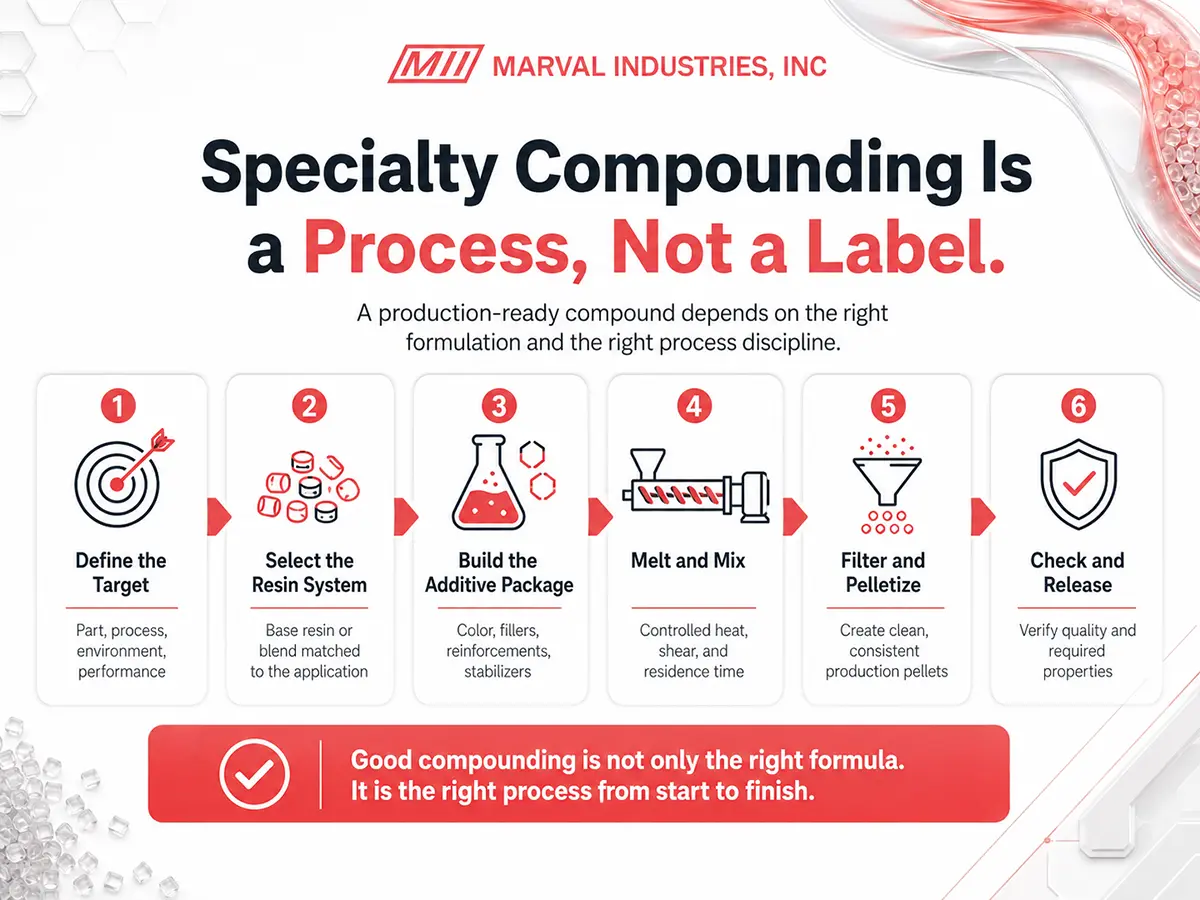
Specialty compounding is not a label placed on a resin after the fact. It is a controlled process tied to the buyer’s application, processing method, and performance target. The work starts with the part requirement, then moves into resin selection, additive selection, feeding, melting, mixing, venting, filtration, pelletizing, and release checks.
That process matters because a weak compound is not always a weak idea. The issue might come from poor dispersion, moisture, contamination, unstable feeding, heat history, insufficient filtration, or a release plan that does not match the finished part. A production-ready compound needs the right formulation and the right process discipline.
Pellet form matters because the customer still has to run the material. Pellets need to feed consistently, carry the formulation evenly, and support the next process. A specialty compound that performs in theory but creates problems in the customer’s machine has not solved the production problem.
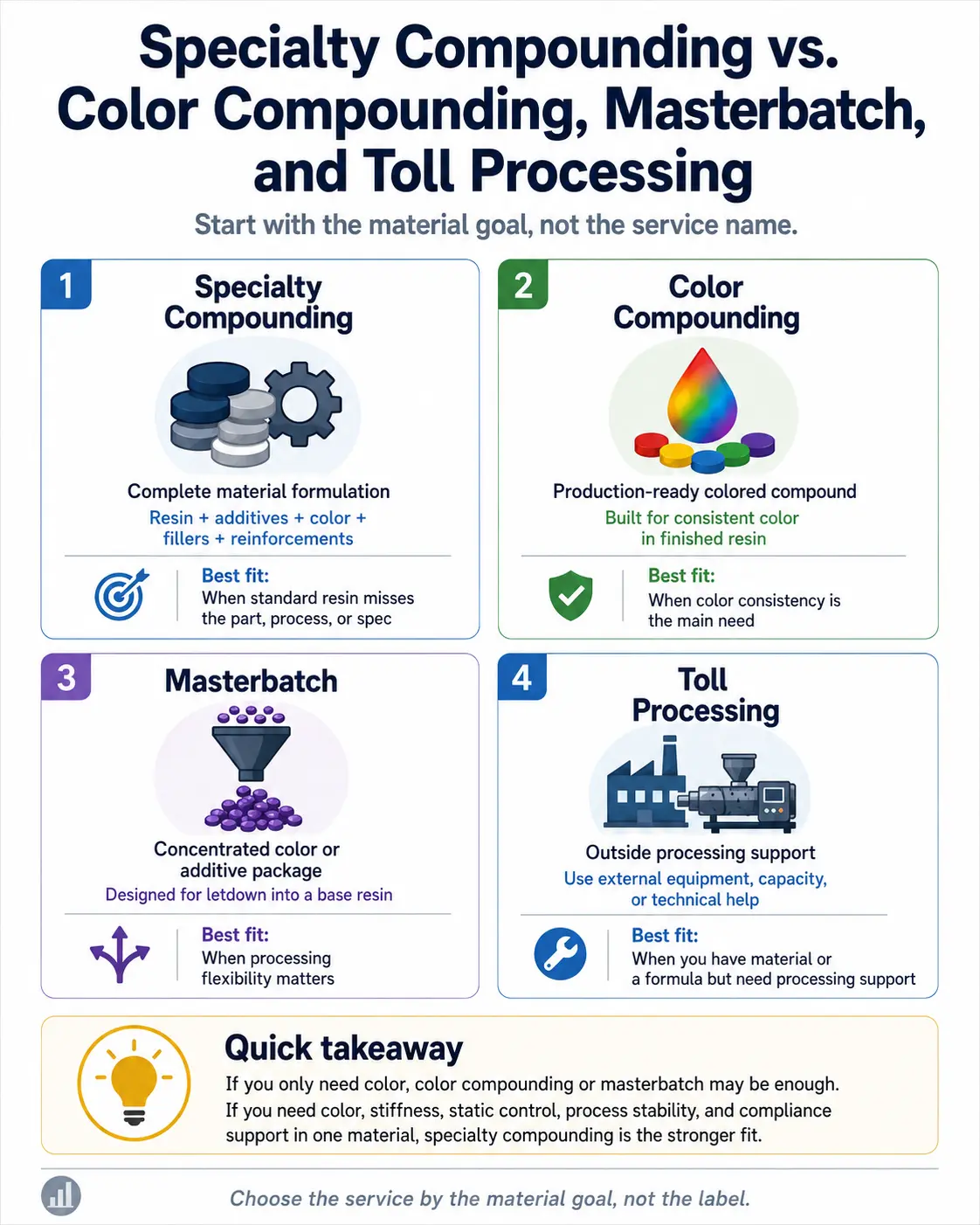
Specialty compounding often gets grouped with color compounding, masterbatch, and toll processing. Those services overlap, but they do not solve the same buying problem. A manufacturer choosing between them should start with the material goal, not the service name.
Color compounding focuses on fully compounded colored resin. Masterbatch provides a concentrated color or additive package for letdown into a base resin. Toll processing gives a customer access to processing capacity, equipment, or technical support without requiring a major capital investment. Specialty compounding is broader because it builds the resin, additives, color, fillers, reinforcements, and performance requirements into a complete material.
Term |
Meaning |
Best fit |
Specialty compounding |
A full resin formulation built around targeted properties and process needs. |
When standard resin misses the part, process, or specification. |
Color compounding |
A production-ready colored compound. |
When color consistency is the main requirement. |
Masterbatch |
A concentrated additive or color package. |
When a processor wants letdown flexibility. |
Toll processing |
Processing material for a customer using outside equipment or capacity. |
When a customer has material or a formula but needs processing support. |
A manufacturer that only needs color might not need a full specialty compound. A manufacturer that needs color, stiffness, static control, process stability, and compliance support in a single material faces a different problem. The more requirements the resin must meet simultaneously, the more important the full compound becomes.
Specialty plastic compounding is not always the right answer. If a standard resin already meets the part, process, appearance, compliance, and production requirements, a simpler material path may suffice. The conversation changes when requirements start competing with each other, such as color consistency, stiffness, process stability, ESD behavior, filler loading, and documentation support.
Marval fits that conversation because its work sits at the intersection of resin, color, additives, fillers, blends, extrusion, pelletizing, and production scale. For manufacturers, the point is simple. When standard resin is close but not complete, specialty plastic compounding helps build the material around the job it has to do.
315 Hoyt Ave Mamaroneck NY 10543
customerservice@marvalindustries.com
customerservice@marvalindustries.com
(914) 381-2400


