


Phone: (914) 381-2400E-Mail: customerservice@marvalindustries.com
A flame-retardant plastic order often starts with a simple request: the finished part needs to meet a fire-performance requirement. The harder question comes after that. The material still has to go through the right process, maintain the right color, maintain the right strength, and perform as the finished product demands. When any one of those requirements is treated as separate from the others, the material becomes a production risk instead of a solution.
At Marval, we work with manufacturers that need more than a resin name or an additive recommendation. Flame-retardant plastic has to be tailored to the resin, application, processing method, and testing target. The right plastic resin suppliers help manufacturers ensure that the full material decision is made, so flame performance does not come at the expense of part quality, color consistency, processing stability, or production reliability.
A flame-retardant compound should start with the finished part, not the additive. A molded enclosure, electronic housing, appliance component, medical part, or transportation component may all require flame-retardant plastic, but each part places different demands on the material. Wall thickness, resin family, color, strength, processing method, and end-use environment all affect the choice of compound.
In Combustion Fire Tests for Plastics, Underwriters Laboratories, a testing and certification organization often known as UL, explains that plastic combustion testing evaluates how a material behaves after ignition, including whether it extinguishes or allows flame spread. That testing context matters because flame retardance is not a broad material promise. It is a measured response under defined conditions.
A manufacturer needs the fire-performance target early on to confidently shape the compound, ensuring it aligns with the full application context and reduces uncertainty.
Flame-retardant additives do not work in isolation. They interact with the base resin. Polypropylene, polycarbonate, nylon, ABS, polyester, polyethylene, and other polymers behave differently under heat, flow differently during processing, and respond differently to additives. The wrong match between the resin and additive package results in a compound that appears acceptable on paper but causes problems during production or testing.
In The Flame-Retardant Mechanisms and Preparation of Polymer Flame-Retardant Materials, published in Polymers in 2021, the authors describe flame-retardant systems via mechanisms including gas-phase activity, char formation, heat shielding, and condensed-phase protection. Those mechanisms depend on the polymer system. A flame-retardant strategy that supports one resin does not automatically transfer to another resin with the same result.
That point matters for manufacturers because the resin still has to support the final part. A flame-retardant additive package affects more than ignition behavior. It affects the material system. Depending on the formulation, the finished compound may change in impact strength, stiffness, elongation, thermal behavior, surface appearance, or flow. In real production, those changes show up as cracking, brittleness, poor fill, color shift, surface defects, or inconsistent finished parts.
The better supplier question is not only, “Do you have flame-retardant plastic?” But also, “Which resin and additive package will reliably meet this part's needs?" This builds confidence in the supplier's expertise.
A flame-retardant compound that passes a material test but creates processing trouble still fails the manufacturer. Injection molding, extrusion, blown-film extrusion, blow molding, rotational molding, and thermoforming all place different demands on the resin. Flow, melt strength, dispersion, heat stability, drying, screw design, and residence time all affect how the compound behaves during production.
ASTM International’s Plastics Standards lists test methods for tensile properties, impact resistance, melt flow, oxygen index, burning behavior, and related performance measurements. ASTM International develops technical standards used across plastics, materials, manufacturing, and testing. Its plastics standards matter because flame-retardant plastic has to be evaluated as a working material, not only as a sample exposed to flame.
Manufacturers do not buy flame-retardant plastic for a lab report alone. They buy it for parts that have to be produced repeatedly. The material has to move through the machine, fill or form correctly, cool predictably, meet dimensional expectations, and leave the line with the required physical properties. If a flame-retardant package interferes with those production conditions, the material creates cost even if it meets one fire-performance target.
When flame-retardant additives are incorporated into the formulation, they affect how the material flows, how heat moves through the melt, how evenly the additive disperses, and how the finished part performs. A high additive load may improve one fire-related target while creating other problems. More additives are not automatically better. Better formulation means the compound reaches the needed fire-performance level while preserving the properties the part still requires.
Start your flame-retardant plastic discussion with clear application details, as this sharpens the focus and guides accurate resin and additive selection.
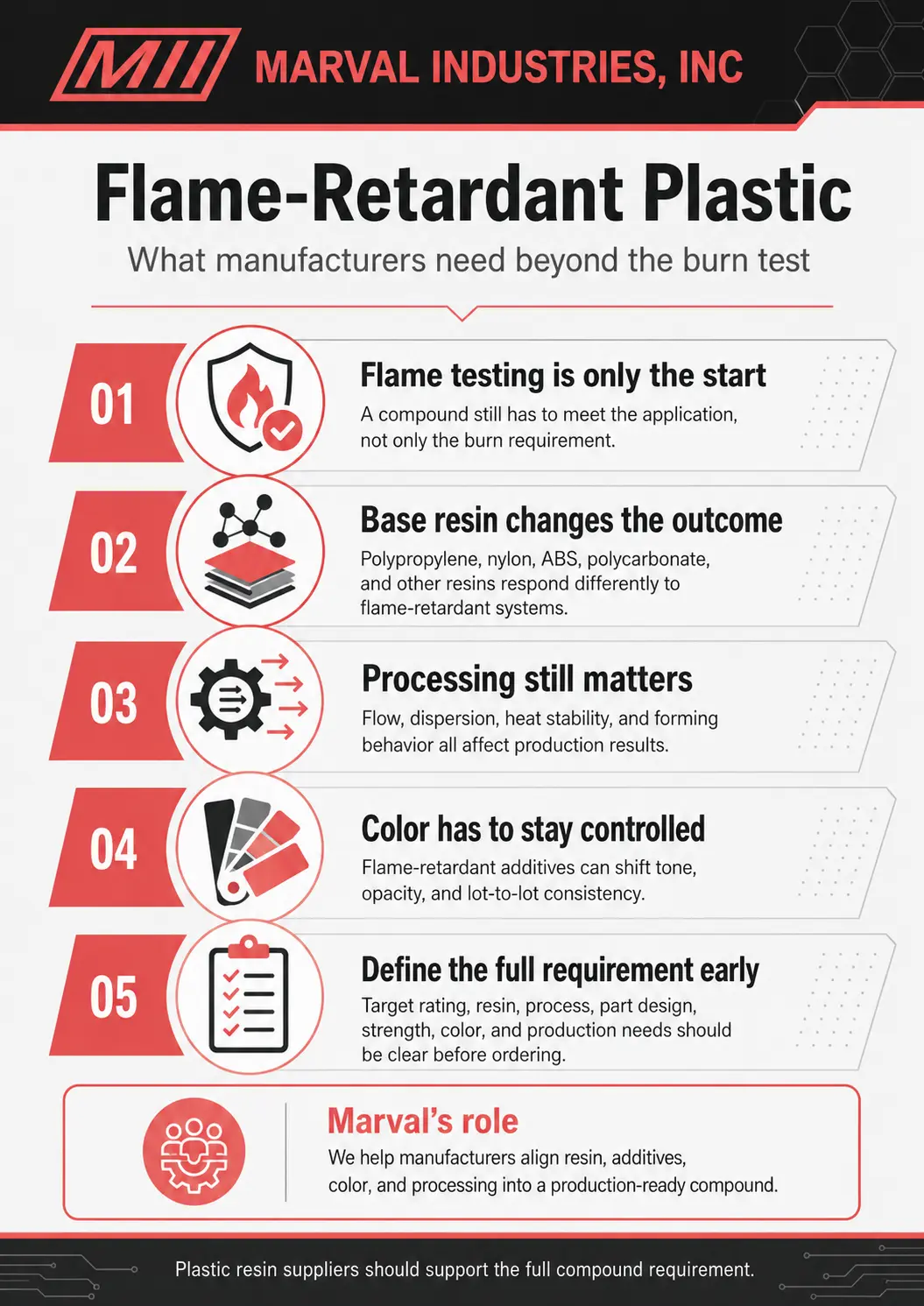
Before ordering, manufacturers should define:
Those details turn the conversation from a resin request into a compound requirement. That matters because flame-retardant plastic is not selected in a vacuum. The material must meet the fire target while still behaving like a production-ready resin in the manufacturer’s actual equipment.
In Flammability Properties of Polymers and Polymer Composites, published in e-Polymers in 2023, the authors explain that flame retardants inhibit ignition and flame spread, but performance depends on the polymer and composite system. That source supports the central production issue: the additive is only one part of the finished material. The compound’s behavior depends on the relationship between the polymer, additives, structure, and processing conditions.
That relationship is where manufacturers face the real risk. A material decision based solely on fire performance can lead to failures elsewhere in the production process. A better compound decision weighs the fire target against the physical and processing requirements that must still be met.
Requirement |
What the Supplier Needs to Know |
Why It Changes the Compound |
Flame-performance target |
UL rating, oxygen index, customer spec, or internal requirement |
The target affects the additive type, the additive loading, and the resin direction |
Base resin |
Polymer family, grade preference, or acceptable alternatives |
Different polymers respond differently to flame-retardant systems |
Processing method |
Injection molding, extrusion, blow molding, thermoforming, or another process |
Flow, heat stability, melt behavior, and dispersion requirements change by process |
Part design |
Wall thickness, geometry, ribs, thin sections, or large surfaces |
Burn behavior, fill behavior, cooling, and part strength depend on design |
Mechanical performance |
Impact strength, stiffness, flexibility, wear, or durability |
Flame-retardant additives may shift physical properties |
Color and appearance |
Color match, opacity, gloss, surface finish, or visual tolerance |
Additives may alter tone, brightness, or surface quality |
Production needs |
Volume, delivery schedule, lot control, and repeatability |
The compound must stay consistent beyond the first approved sample |
Each requirement narrows the formulation. A manufacturer that defines these details early gives the supplier a stronger path to the right compound. A manufacturer that leaves these details open risks ordering a material that answers the burn requirement but misses the production requirement.
Flame-retardant plastic should not be selected by additive name alone. A manufacturer looking for this material is usually trying to reduce risk before production, whether the part needs to meet a customer specification, support a regulated application, improve ignition resistance, or satisfy an internal safety requirement. Fire performance matters, but so do resin compatibility, processing stability, color control, part strength, and repeatable production. The supplier’s job is to reduce material uncertainty before the order reaches the line, not simply ship resin and leave the buyer to solve the formulation.
At Marval, we help manufacturers source and develop plastic materials with the full application in mind. We support that process through resin supply, custom compounding, color matching, additives, masterbatch, formulation development, blending, drying, and production-scale material handling. When a part requires flame-retardant plastic, we look at the resin, additive package, color system, processing method, and production needs together. For manufacturers comparing plastic resin suppliers, the right partner is the one that understands the full compound, not only the flame-retardant requirement.
315 Hoyt Ave Mamaroneck NY 10543
customerservice@marvalindustries.com
customerservice@marvalindustries.com
(914) 381-2400


