


Phone: (914) 381-2400E-Mail: customerservice@marvalindustries.com
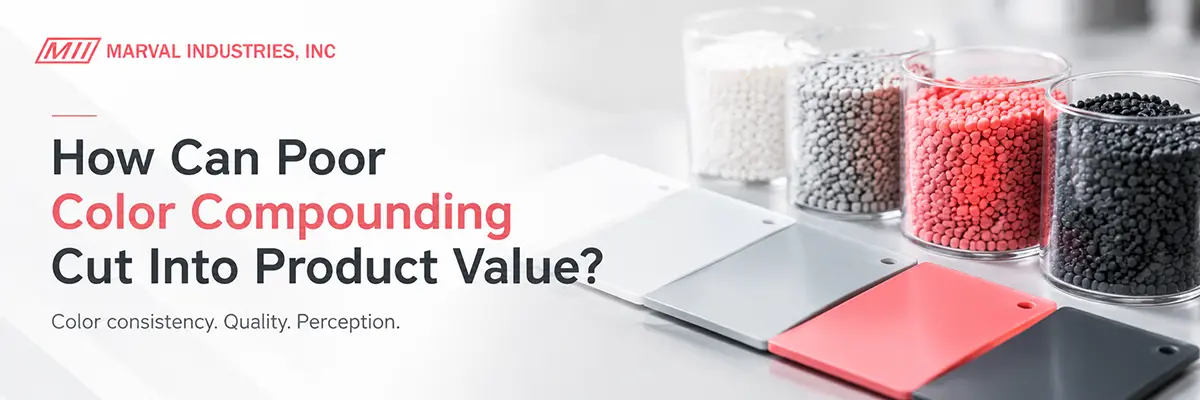
A product's color starts working before the customer touches it, tests it, or reads its specifications. It tells the buyer whether the product feels finished, consistent, recognizable, and worth trusting. When the color appears dull, uneven, streaked, faded, or slightly off the approved standard, the problem is no longer purely visual. It can make a well-made plastic product feel cheaper than it is.
Color compounding matters because color has to hold up through real production, not just look good on a sample or design file. A target shade still has to work with the resin, process cleanly, maintain the right appearance across batches, and fit the conditions the product will face after production. When color control is weak, the result can be scrap, rework, longer changeovers, increased inspection, batch mismatches, customer complaints, and lower product value. At Marval Industries, color is treated as part of the full material specification because a finished plastic color depends on more than visual preference.
Color helps customers understand what a product is, what category it belongs in, and whether it feels right for the intended use. Research on packaging color shows that color can influence purchase intent when it fits the product type and helps people process the product more easily. In one study, warm-colored packaging increased purchase intent for indulgent food products, while cooler-colored packaging increased purchase intent for products positioned as healthier options. That finding matters because it shows color should match the product, audience, and buying context rather than follow a generic color rule.
A poor color choice can make a product feel disconnected from its purpose before the customer evaluates its performance. Red does not automatically make a product feel strong. Blue does not automatically make every product feel trustworthy. Green does not automatically prove sustainability. The stronger question is whether the color, saturation, finish, and final plastic appearance match the buyer's expectations for that product.
For plastic products, this makes color compounding part of product strategy. The final material must deliver the intended look in the actual molded, extruded, or finished part. A color that works in a design file, sample chip, or early concept can still look wrong once it is processed into the final product. If the finished part feels off-category, cheap, cloudy, uneven, or mismatched, the color choice has already started working against the product.
A good color choice loses value if it cannot be repeated. Customers expect the same product to look the same across batches, product lines, packaging, and marketing materials. Research on familiar brand logos shows that correctly colored familiar logos help people recognize and process brands faster than incorrect-color or achromatic versions. That supports a basic manufacturing reality: color consistency helps protect recognition, familiarity, and perceived quality.
Inconsistent color can make customers question quality even when the part still performs correctly. Parts from different lots may not match. Replacement components may look different from the original. Packaging, sales samples, and finished parts may feel disconnected from one another. These issues can create doubt because customers often read color drift as a sign that something changed in the product.
That does not mean every molded part needs an extreme color tolerance. It means manufacturers need to define what correct color means before production. A color target should account for the part, material, acceptable variation, and end use. Without that control, small color shifts can become larger business problems once parts move into inventory, assembly, distribution, or customer inspection.
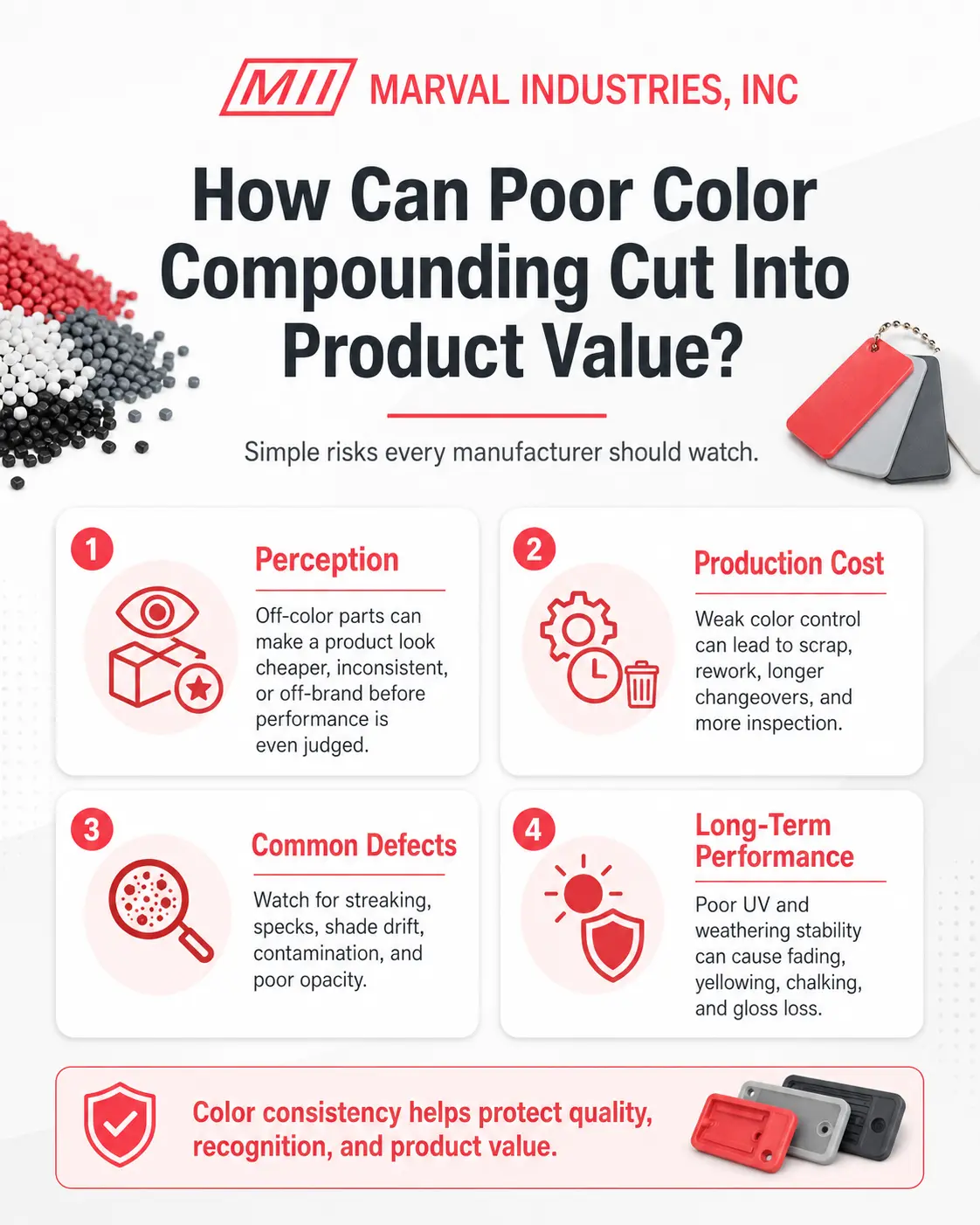
Color problems in plastics are not always minor. Research on injection molding color changeover found that poor colorant distribution after changeover can lead to defects, increased material use, and extended machine downtime. That gives the cost argument a stronger foundation. Poor color control does not automatically destroy profitability, but it can add cost through production inefficiency.
These issues can lead to rejected parts, rework, longer setup times, added purge material, and more inspection. In tight production schedules, those delays matter. A color problem that starts as a visual defect can become a yield, delivery, or customer-confidence problem. If the issue reaches the customer, the cost can also include replacement parts, complaint handling, and a weaker perception of the manufacturer's quality control.
Color-related problems often begin as minor appearance flaws but can create larger production and business issues once parts are in process. The risks usually connect to dispersion, repeatability, resin compatibility, changeover control, opacity, and exposure conditions. These are not separate from product value. They affect how much material is wasted, how much inspection is needed, and whether the finished part meets the approved standard.
Color Compounding Issue |
What It Can Look Like |
Why It Can Cost More |
Poor Pigment Dispersion |
Streaks, specks, cloudy areas, uneven shade |
Parts may require extra inspection, rework, or rejection. |
Weak Batch-To-Batch Control |
One production run looks different from another |
Finished products may not match prior inventory, samples, packaging, or customer standards. |
Poor Colorant And Resin Compatibility |
Inconsistent appearance, processing issues, weak color strength |
The compound may not process cleanly or produce the intended shade in the final part. |
Poor Changeover Control |
Old color carries into the next run |
Manufacturers may need more purge material, more downtime, and more rejected startup parts. |
Wrong Opacity Or Translucency |
Color looks too thin, too dark, or inconsistent across wall thicknesses |
The part may not meet the intended visual standard, even when the pigment color is correct. |
Poor UV Or Weathering Stability |
Fading, yellowing, chalking, or gloss loss |
Outdoor or exposed products may lose appearance quality before the expected service life. |
These problems often start with small technical decisions. The pigment system, carrier resin, masterbatch loading, melt temperature, shear, opacity, and processing window all affect the finished result. When those variables are not controlled, the product color can drift from the approved standard. That drift can force manufacturers to spend more time deciding whether a part is acceptable instead of producing consistent material from the start.
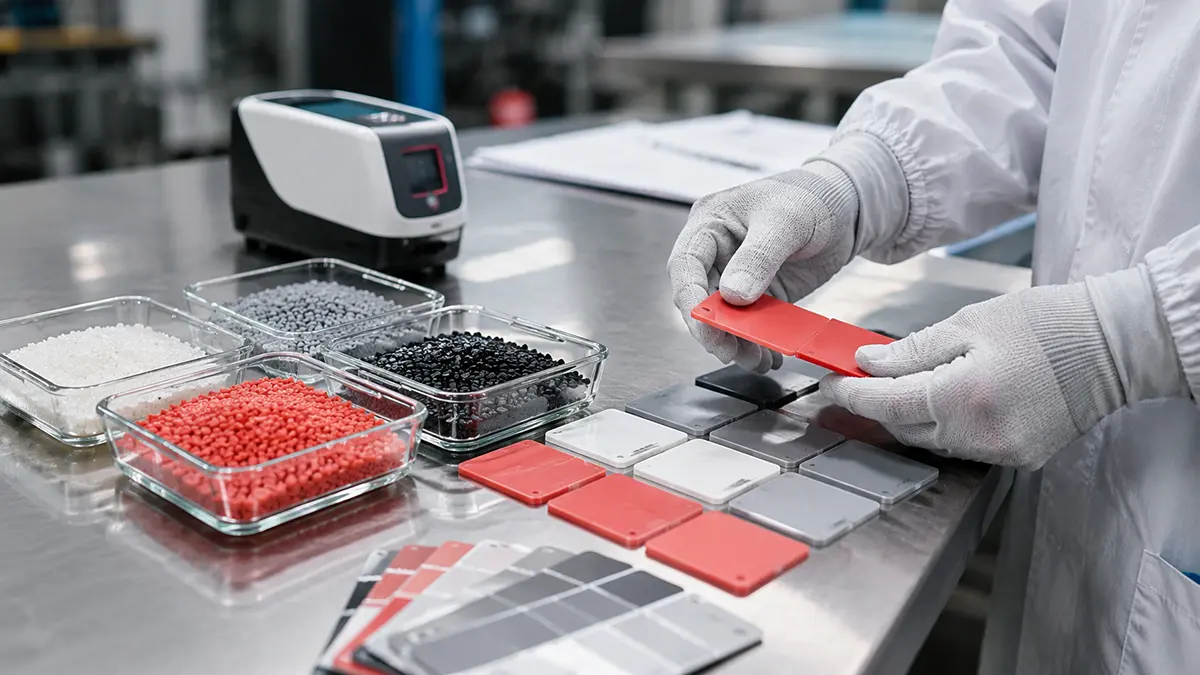
Some products need more than a strong color match at production. They need color stability in sunlight, heat, moisture, and when exposed to cleaning chemicals or outdoor conditions. Government weathering research on vinyl siding measured color shift, yellowness, roughness change, and brittleness after UV and weathering exposure. The results showed that appearance changes can be linked to deeper material degradation, not just surface discoloration.
For customers, this matters when color has to hold up in the field. A part may look right when it ships, but fade, yellow, chalk, or lose gloss too quickly if the formulation does not match the application. That kind of failure can make the product look older, cheaper, or less reliable than intended. It can also create questions about whether the material was specified correctly for the environment.
Outdoor and exposed applications need color planning that accounts for more than the approved shade. UV stabilizers, pigment selection, resin choice, and end-use testing all factor into the color decision. A good initial match is only useful if the material keeps an acceptable appearance through the conditions the product is expected to face. Without that planning, the color can fail after production, when correction becomes harder and more expensive.
The right color can help a product look finished, recognizable, and aligned with the brand. The right compound helps that color remain consistent through production and appropriate for the application. That consistency matters because customers do not separate appearance from quality when they judge a finished product. If the color looks wrong, they may assume the product itself is wrong.
Poor color planning can create the opposite result. It can make a product look cheaper than intended, create batch mismatches, slow production after changeovers, or cause color defects that require rework. These problems do not always surface in the design stage, but they can become expensive once materials are in production. They can also create avoidable friction between manufacturers, suppliers, brand owners, and customers.
Color compounding connects product appearance to manufacturing reality. When the resin, pigment, processing conditions, color standards, and end-use requirements work together, color becomes a controlled part of product quality instead of a source of avoidable cost. At Marval Industries, the purpose of color compounding is to help customers create plastic materials that look consistent, process reliably, and protect the value of the finished product.
315 Hoyt Ave Mamaroneck NY 10543
customerservice@marvalindustries.com
customerservice@marvalindustries.com
(914) 381-2400


